
Kryptos Zippo by W.O.E.: a lighter combining military culture, espionage and cryptography
A practical accessory that gradually became a personal item and sometimes a memento of military service, the Zippo lighter has a long-standing connection with the American military world. The Kryptos Zippo by W.O.E. draws on this history while adding a reference directly from the world of intelligence: Kryptos, the famous cryptographic sculpture installed at CIA headquarters in Langley, Virginia. Based on a Zippo 1941 Replica, this model brings together three worlds: the history of the American lighter, its use by several generations of military personnel and intelligence culture. Its design features a modified section of the Kryptos code, accompanied by the Watches of Espionage Spearhead logo. It is available from €45.

A Zippo inspired by the world of intelligence
The Kryptos Zippo stands out for the engraving covering one of its sides. It directly references Kryptos, a work by American artist Jim Sanborn installed in 1990 in the courtyard of the CIA’s New Headquarters Building. The name comes from Greek and means “hidden”. The artwork combines several materials, including petrified wood, granite, quartz and, most notably, a large curved copper screen measuring approximately 3.65 metres high. It features exactly 1,735 letters cut into the metal. These characters form various encrypted messages using several cryptographic techniques. Kryptos has consequently become one of the best-known symbols of American intelligence culture, precisely because deciphering it has long posed a challenge to both professional and amateur cryptologists. The lighter does not attempt to reproduce the artwork in its entirety. A modified section of the cipher is laser-engraved onto its surface, turning the object into a visual reference to this world of codes, secrets and cryptography.
Kryptos, an enigma at the heart of the CIA
The installation of Kryptos at Central Intelligence Agency headquarters is far from incidental. Its principle is based on hiding information in plain sight: hundreds of characters are immediately visible, but their meaning can only be accessed through decryption. This concept largely explains the special place the artwork occupies in the imagery associated with intelligence. It embodies several ideas traditionally linked to this world: information gathering, cryptography, interpretation and the protection of secrets. The Kryptos Zippo transposes this concept onto a pocket-sized object. It obviously has no specific cryptographic function: the reference lies exclusively in its decoration and the story behind it. This distinction is important. It is neither CIA equipment nor a lighter officially issued to its agents. It is a civilian object whose decoration draws inspiration from an artwork installed at the headquarters of the American agency.
Based on the Zippo 1941 Replica
The model is based on the Zippo Brushed Chrome 1941 Replica, a version that recreates several characteristics of the lighters produced by the American brand in the early 1940s. Its silhouette differs notably from contemporary Zippo models through its flatter surfaces and less rounded edges where the front and rear faces meet the sides. The lid is connected to the lower section by a four-barrel hinge, another distinctive feature of this historically inspired construction. The mechanical principle remains that of the traditional Zippo. The all-metal construction houses a refillable fuel insert equipped with a wick and flint. It also retains the brand’s characteristic windproof system and the famous “click” produced when opening and closing the lid. The lighter measures 5.56 cm high, 3.81 cm wide and 1.27 cm thick. It weighs approximately 82 grams. These dimensions remain faithful to the compact format that contributed significantly to the Zippo’s popularity as a pocket accessory.


Zippo and American military history
The choice of the 1941 Replica version directly refers to a defining period in Zippo’s history. Founded in Pennsylvania in the early 1930s, the company became closely associated with the US armed forces during the Second World War. From 1941 onwards, production was directed towards the war effort, and Zippo lighters became familiar objects for many American servicemen. Compact, refillable and capable of working in windy conditions, they naturally found a place among soldiers’ personal equipment. Beyond their primary function, Zippos also became personal objects. Some servicemen had their names, dates, inscriptions or various designs engraved on them. The lighter could therefore become an individual memento of a period of military service. This tradition continued notably during the Vietnam War, when many lighters were personalised with texts, drawings or unit insignia. Today, these objects occupy a particular place in militaria collections, although the authenticity of examples presented as historical pieces should always be approached with caution due to the numerous reproductions that subsequently appeared.
From military lighter to contemporary EDC
The Kryptos Zippo follows this tradition without presenting itself as a reproduction of any particular military-issued lighter. Its 1941 format recalls Zippo’s military history, while its engraving shifts the reference towards intelligence and cryptography. This combination also reflects the evolution of the lighter within EDC, or Everyday Carry, culture. The Zippo is no longer exclusively associated with smoking. Its ability to produce a flame, repairable metal construction and refillable system allow it to retain its function as a pocket tool. The design remains deliberately simple. The fuel, flint and wick can all be replaced, while the metal construction is intended for prolonged use. The lighter is manufactured in the United States, in Bradford, Pennsylvania, and benefits from the lifetime guarantee traditionally associated with Zippo lighters.
An object between militaria and espionage culture
The Kryptos Zippo ultimately shares a characteristic with certain contemporary military watches: it combines a functional object with a history and visual codes drawn from the worlds of the military and intelligence. Its connection with this universe should nevertheless be clearly defined. The model is not operational CIA equipment, and its Kryptos engraving does not give it any intelligence-related function. Its military dimension is primarily based on the history of Zippo and the brand’s longstanding links with the US armed forces. The reference to Kryptos adds another layer of meaning. Whereas a historic military Zippo might have carried a name, an insignia or a reference to a particular unit, this version uses a fragment of an encrypted message to evoke the culture of secrecy.
Kryptos Zippo by W.O.E.: when a lighter tells a story
With its all-metal construction, refillable mechanism and format based on the Zippo 1941 Replica, the Kryptos Zippo remains first and foremost a functional lighter. Its distinctive character lies in the way this historical foundation is combined with a contemporary symbol of American intelligence. The engraving inspired by the 1,735 characters of Kryptos creates a link between two different histories. The first is that of Zippo and the personalised lighters carried by American servicemen since the Second World War. The second belongs to the world of cryptography and to a sculpture that has become inseparable from CIA headquarters. The Kryptos Zippo sits at the intersection of these two cultures. Neither a reproduction of a historic military object nor a piece of espionage equipment, it is instead a contemporary interpretation of an iconic American accessory, bringing together Zippo’s military history with the codes of intelligence and cryptography.
More…

Red pushers and military watches: the history of an iconic detail
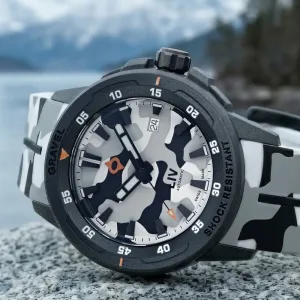
LIV Gravel Nordic Camo Auto: an automatic watch with military styling
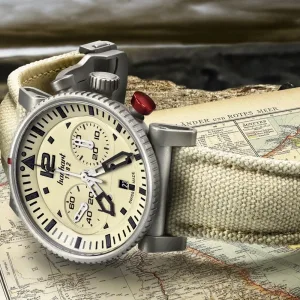
Hanhart PRIMUS Desert Pilot: an aviator chronograph built for adventure
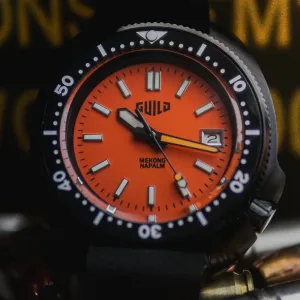
Guild Mekong: an American tool watch inspired by the Seiko 6105
Get ready for the next dive! Receive our latest news and inspiration dedicated to military and dive watches.
Subscribe
Editor: Éric Barse
Journalist, entrepreneur, and founder of the websites www.cafe-racer-only.com and www.scooter-3-roues.com, Eric Barse divides his time between his passions: motorcycles, travel, and watches. A graduate of the Saint-Cyr military academy and the 2nd RPIMA (Parachute Regiment) before pursuing a career in communications and digital media, he has a true passion for authentic watches that have accompanied his two-wheeled adventures for many years, from the Indian Ocean to Africa and Latin America!