
The Real McCoy’s P1944 Frogskin: when Marine camouflage is reborn in Japan
There are military garments whose appeal extends far beyond their primary function. They tell the story of an era, a doctrine, and sometimes even the trial and error of an army facing a new form of warfare. The P1944 Reversible Frogskin Camouflage Coat undoubtedly belongs to this category. Reproduced today by the Japanese company The Real McCoy’s, this jacket transports us directly to the Pacific of the 1940s, when American forces were experimenting with new uniforms capable of better concealing their men in the jungles and on the beaches of the Pacific islands. The garment also embodies the philosophy of The Real McCoy’s, a Japanese company that has become a benchmark for enthusiasts of military clothing, workwear, and vintage Americana. Rather than simply drawing inspiration from American archives, the brand seeks to recreate the materials, constructions, and even the sometimes almost invisible details of the original garments. With this P1944, this approach takes on a special dimension: The Real McCoy’s is not just reviving a jacket, but one of the first chapters in the history of military camouflage. It is available from €500.

The real McCoy’s: military america as seen from Japan
To understand a jacket like the P1944 Frogskin, one must first understand the astonishing Japanese fascination with 20th-century American clothing. From the second half of the century onward, Japanese collectors and manufacturers developed a particularly deep knowledge of American denim, bomber jackets, workwear, and military uniforms. Original pieces are studied, collected, and sometimes disassembled to understand their fabrics, seams, dyes, and manufacturing methods. The Real McCoy’s is fully part of this culture. The brand is associated with Hitoshi Tsujimoto and Kobe, Japan, and has built its identity around the meticulous reproduction of great American classics. Flight jackets, US Navy deck jackets, US Army clothing, and workwear pieces are approached with an almost archival logic: reproducing not only the appearance of an antique garment, but also its construction and how it will evolve over time. This approach explains why some of The Real McCoy’s creations appeal to both collectors and contemporary fashion enthusiasts. The brand does not seek to systematically modernize the pieces it reproduces. On the contrary, it embraces certain characteristics of historical garments—their volumes, materials, and functional details—precisely because they tell the story of their origins.


Frogskin: the origins of american camouflage
The P1944 is inextricably linked to its pattern. Frogskin camouflage is generally considered the first camouflage specifically developed and adopted by the U.S. Army. Its appearance coincided with the beginning of World War II, when the United States needed to prepare its forces to fight in environments vastly different from those encountered until then. The pattern entered service in 1942 during operations in the Pacific. Its principle is particularly interesting: the fabric is reversible. One side features a pattern of green and brown spots designed for vegetation and jungle environments, while the other uses lighter tones, dominated by beige and brown, to better match beaches and less vegetated terrain.
The nickname "Frogskin" is not its official military designation. It comes from the organic appearance of the spots, which resemble the skin of a frog. The pattern is associated with Norvell Gillespie, an American horticulturist interested in natural camouflage mechanisms. The idea was to visually break up the human silhouette through irregular shapes and multiple shades of color. In the Pacific, where Marines had to advance first on open beaches and then through dense vegetation, the idea of a reversible uniform made perfect operational sense. The same garment could theoretically be adapted to two very different environments without requiring a second uniform.
An experiment that quickly revealed its limitations
On paper, Frogskin seemed particularly ingenious. In the field, its story would prove more complicated. Initial feedback showed that certain shades of the green side were too bright or too contrasting to provide the desired level of camouflage in some Pacific jungles. The camouflage also saw limited use by the US Army in the European theater. An unexpected problem then arose: from a distance, the design could be mistaken for certain camouflage patterns used by German forces. This visual similarity led to identification problems and contributed to limiting enthusiasm for its use in Europe. Nevertheless, Frogskin would remain closely associated with the Marines and the Pacific theater. Early versions were notably worn by units engaged in island campaigns, and the pattern gradually became one of the most recognizable American camouflage patterns of World War II.


P1944: a jacket designed from field experience
The P1944 emerged during a period of constant evolution in Marine Corps equipment. Lessons learned from the early years of the war led to a search for more practical clothing, offering greater carrying capacity and better adaptation to field conditions. The development of the two-piece P1942 had already been a significant step forward; the P1944 took this functional approach even further. The most striking feature of the jacket is the size of its chest pockets. Very generous, they were designed to carry maps and various equipment. At a time when soldiers obviously lacked modern modular systems, the garment itself directly contributed to carrying capacity. The silhouette of the P1944 thus stemmed primarily from operational necessity. The historical paradox is that this evolution came late. By the time the P1944 began to be more widely distributed, the Pacific War was already nearing its end. Furthermore, camouflage clothing remained relatively uncommon. Historical examples of the P1944 Frogskin are therefore much less common than the pattern's fame might suggest today.
The Real McCoy’s reproduction
It is precisely this garment that The Real McCoy’s has chosen to bring back into production. The P1944 Reversible Frogskin Camouflage Coat, reference MJ26003, is made in Japan from HBT cotton twill, or Herringbone Twill. This herringbone-structured fabric is closely associated with American utilitarian clothing of this period and contributes significantly to the jacket's distinctive appearance. The Real McCoy’s uses 100% cotton HBT on which the reversible camouflage pattern is printed. Thus, the two sides of the original uniform are retained: a green side designed to evoke the jungle and a lighter side suited to sandy environments. This reversibility is not merely an aesthetic device. It is one of the reasons for the historical garment's existence and directly reflects the constraints faced by Marines in the Pacific.
The construction also uses cotton thread and brass metal buttons with an oxidized black finish. The Real McCoy’s reproduces a particularly interesting detail here: so-called “economy type” buttons. On some historical productions, manufacturers reportedly used this type of civilian hardware when buttons marked with the USMC logo were unavailable. This is precisely the kind of detail that illustrates the Japanese company’s approach: reproducing the particularities and irregularities of wartime production rather than offering an idealized version.
A military jacket that became a collector’s item
The Frogskin’s story didn’t end with World War II. After 1945, American military surplus stores released significant quantities of clothing that was gradually being phased out of military use. Veterans and hunters acquired these sturdy garments and discovered that the camouflage worked particularly well in woods and marshy areas. The pattern then began a second life in the world of hunting. Civilian manufacturers took inspiration from it, and Frogskin gradually became associated with "duck hunter camouflage." This lineage is significant: it demonstrates how equipment designed in the urgency of the Pacific War contributed to the emergence of a true camouflage culture in American outdoor clothing. More than eight decades after its introduction, Frogskin has also transcended the purely military and hunting domains. Its irregular pattern, colors, and history have made it a sought-after motif in the world of heritage clothing. Like many military items that have become civilian classics, the P1944 possesses this unique ability to remain instantly recognizable while still being wearable today without any direct reference to the uniform.
The Real McCoy’s P1944 Frogskin: when clothing becomes an archive
The P1944 Reversible Frogskin Camouflage Coat tells several stories simultaneously: that of the US Marines in the Pacific, that of the first camouflage patterns used by the United States Armed Forces, that of the transformation of military surplus into hunting clothes, and also that of the Japanese fascination with American sartorial heritage. The Real McCoy’s does more than simply reproduce a 1940s silhouette. By preserving the HBT (High-Body Tapered) construction, the reversible design, the large pockets, and even the button details, the Japanese company is bringing back into circulation a particularly unique piece of military clothing history. A jacket born to fade into obscurity, which, more than eighty years later, has become impossible to miss.
More…
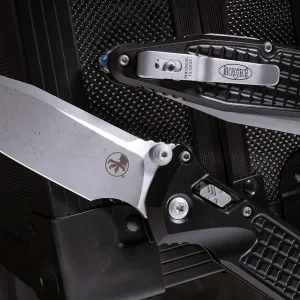
Microtech SOCOM RAM-LOK: an American tactical knife bridging military heritage and EDC.
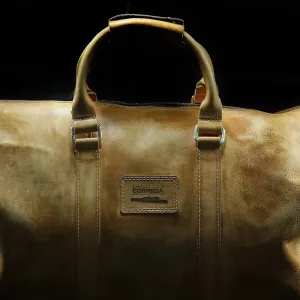
Military-style leather bag: the Corrigia C01 Cartella Militare focuses on German craftsmanship.
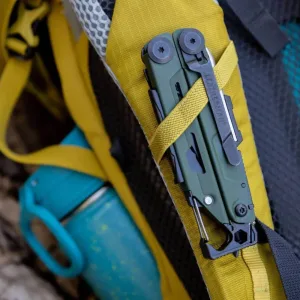
Leatherman Signal: the multi-tool designed for outdoor use and self-sufficiency
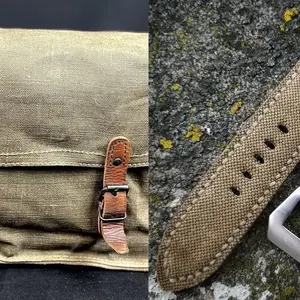
Xamlam Strap: when old military satchels become unique watch straps
Get ready for the next dive! Receive our latest news and inspiration dedicated to military and dive watches.
Subscribe
Editor: Éric Barse
Journalist, entrepreneur, and founder of the websites www.cafe-racer-only.com and www.scooter-3-roues.com, Eric Barse divides his time between his passions: motorcycles, travel, and watches. A graduate of the Saint-Cyr military academy and the 2nd RPIMA (Parachute Regiment) before pursuing a career in communications and digital media, he has a true passion for authentic watches that have accompanied his two-wheeled adventures for many years, from the Indian Ocean to Africa and Latin America!