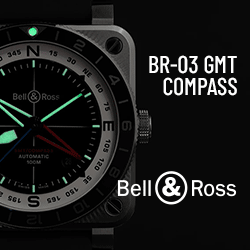

Commando watches and Special Forces watches: what's the difference?
In the vast world of military watches, certain terms have become marketing shortcuts. Among them, two terms constantly reappear and are often used synonymously: Commando watch and Special Forces watch. Yet, behind these evocative words lie distinct historical, functional, and operational realities. Understanding this difference not only allows for a better understanding of military history but also enables more informed choices when considering these utilitarian timepieces.

Commando Watches and Special Forces Watches: Two Philosophies, Two Uses, One Shared Requirement
The Commando watch has historically been associated with conventional assault troops. The term “commando” refers to light infantry or amphibious units, often specializing in rapid operations, but integrated into a traditional military structure. Watches associated with these units appeared primarily during the 20th century, particularly during and after World War II, in a context where the military began equipping its personnel en masse with robust wristwatches. Conversely, Special Forces constitute a world apart. These are highly specialized units, often operating discreetly, clandestinely, or deep within strategic depths. Their watches are not designed for widespread distribution, but for specific missions, sometimes far removed from conventional military standards. This difference in context influences almost everything: conception, distribution, design, and even public visibility.
Commando Watch: The Robust and Legible Tool
The so-called “Commando” watch is first and foremost a tool watch. Its primary mission is simple: to tell the time reliably, legibly, and consistently, regardless of the conditions. It prioritizes:
- Immediate readability (clear numerals, high contrast),
- A robust construction (steel case, sufficient water resistance),
- Mechanical simplicity for easy maintenance,
- Standardization enabling large-scale production and distribution.
Historically, these watches often originated from official military specifications. They can be produced by civilian manufacturers, but must adhere to precise standards. Their aesthetic is generally understated, functional, sometimes austere. The notion of “style” is secondary; effectiveness is paramount.
Today, the term “Commando” is widely used in the watchmaking industry to describe watches with a military look: matte cases, black dials, and canvas or steel straps. But in its strict sense, the Commando watch remains associated with a logic of endowment and collective use.


Special Forces Watches: Discretion and Adaptability
Watches associated with Special Forces operate according to a radically different logic. Here, the focus is no longer on standardization, but on adapting to the mission. In many cases, there isn't even an "official watch" for Special Forces. Operators choose their own equipment based on highly personal criteria.
Priorities change:
- Absolute discretion (no glare, minimal noise),
- Versatility (timekeeping, time zones, sometimes navigation),
- Compatibility with other equipment (gloves, night vision, weapons),
- Reliability without immediate maintenance.
Unlike Commando watches, Special Forces watches can be purchased individually, modified, or even replaced regularly. They are not always mechanical: quartz, digital, or tactical smartwatches are all suitable, provided they meet operational needs.
Design: Visibility versus Invisibility
Visually, the difference is often striking. The Commando watch embraces a certain functional visibility: wide hands, generous hour markers, sometimes pronounced luminescence. It must be legible in a fraction of a second, even for a soldier unfamiliar with the device. Conversely, the Special Forces watch often seeks to be unobtrusive. Matte dials, compact sizes, absence of conspicuous logos, or even the complete removal of any signature. Legibility remains essential, but never at the expense of discretion. A watch that is too conspicuous can become a liability on a mission.
Relationship to Image and Myth
Another fundamental point distinguishes these two categories: their relationship to communication. Commando watches have often been documented, photographed, sometimes celebrated. They belong to the visible history of the armed forces and are now widely collected. Special Forces watches, on the other hand, exist in a gray area. Many accounts are fragmented, sometimes exaggerated, and often appropriated for marketing purposes. A watch worn by a Special Forces operator isn't necessarily designed for that purpose from the outset. It's chosen because it works, not because it tells a story.
Two visions of military time
In short, the Commando watch represents a collective and institutional vision of military time: a common, reliable, standardized tool designed to support entire units in known operational contexts. The Special Forces watch embodies an individual and adaptive vision: time becomes one parameter among others, integrated into a unique mission, with specific, sometimes extreme, constraints.
Choosing Between Commando Watches and Special Forces Watches
For the enthusiast or collector, understanding this difference helps avoid confusion. An authentic “Commando” watch tells a story of service, doctrine, and the regular army. A watch associated with Special Forces primarily tells a story of use, often personal, rarely official. Both approaches are legitimate. One values robustness and heritage, the other performance and adaptability. But to confuse them is to miss what makes each one unique. Ultimately, whether it's a Commando or Special Forces watch, a true military watch is not defined by its name, but by its ability to fulfill its mission—without compromise, without artifice, and often without witnesses.
Diver photo credits: Subphotos / All rights reserved.
Get ready for the next dive! Receive our latest news and inspiration dedicated to military and dive watches.
Subscribe
Editor: Éric Barse
Journalist, entrepreneur, and founder of the websites www.cafe-racer-only.com and www.scooter-3-roues.com, Eric Barse divides his time between his passions: motorcycles, travel, and watches. A graduate of the Saint-Cyr military academy and the 2nd RPIMA (Parachute Regiment) before pursuing a career in communications and digital media, he has a true passion for authentic watches that have accompanied his two-wheeled adventures for many years, from the Indian Ocean to Africa and Latin America!