
The dive watches of Jacques-Yves Cousteau and the Calypso divers
The history of the military dive watch is closely linked to that of the pioneers who transformed scuba diving from the 1940s and 1950s onwards. Among them, Jacques-Yves Cousteau occupies a special place. A naval officer, explorer, filmmaker and, together with Émile Gagnan, co-inventor of the modern self-contained underwater breathing apparatus in 1943, Cousteau helped make the underwater world accessible to a new generation of divers. His expeditions aboard the Calypso also provided an exceptional testing ground for diving equipment. Regulators, cameras, underwater scooters and watches were all subjected to real-world conditions. Over the decades, several major names in dive watchmaking could therefore be seen on the wrists of Cousteau, his sons and members of his team: Blancpain, Rolex, DOXA and Aquastar, alongside other watches intended more for life aboard the ship. However, it is important to distinguish between watches personally worn by Jacques-Yves Cousteau and those used by different members of his team. Photographs and films sometimes make it possible to identify a family of watches without being able to determine the exact reference with absolute certainty.

Jacques-Yves Cousteau, from the French Navy to underwater exploration
Born in 1910, Jacques-Yves Cousteau entered the French Naval Academy in 1930. His encounter with the underwater world came a few years later and took on a decisive dimension when, together with engineer Émile Gagnan, he developed the self-contained underwater breathing apparatus in 1943. After the war, Cousteau, Philippe Tailliez and Frédéric Dumas formed the group nicknamed the “Mousquemers”, carrying out numerous underwater experiments and explorations. In 1950, the Calypso, a former minesweeper, was converted into an oceanographic research vessel. In November 1951, she set sail for the Red Sea to study coral reefs. She gradually became a laboratory, diving base and floating film studio. Around Cousteau, a team of divers, technicians, scientists and filmmakers took shape. Among those who became emblematic figures were Frédéric Dumas, Albert Falco, André Laban and Claude Wesly, later joined by Cousteau’s sons Philippe and Jean-Michel. This collective dimension is essential when looking at Cousteau’s watches: the timepieces visible in archival footage were not worn exclusively by the Commander.


Cousteau’s films, witnesses to the history of diving
The footage shot by Cousteau’s team now provides exceptional documentation of the evolution of diving. As early as 1943, Épaves documented the first experiments with the self-contained underwater breathing apparatus. But it was above all The Silent World, co-directed with Louis Malle and released in 1956, that introduced Cousteau and the Calypso to a wider audience. The film follows the men of the Calypso in the Mediterranean, the Red Sea, the Persian Gulf and the Indian Ocean. Cousteau, Louis Malle, Frédéric Dumas, Albert Falco and other members of the crew took part in the dives and filming. The Silent World won the Palme d’Or at the Cannes Film Festival in 1956, followed by the Academy Award for Best Documentary Feature in 1957. Cousteau continued with World Without Sun, devoted in particular to the Précontinent underwater habitat experiments, followed by numerous documentaries and television programmes. L’Aventure Précontinent, Les Requins, La jungle de corail, Baleines et cachalots and La nuit des calmars are among this extensive audiovisual production. For watch enthusiasts, this footage is also of particular interest: it shows the instruments actually used by divers at the time.
Blancpain Fifty Fathoms: the quintessential military dive watch
The Blancpain Fifty Fathoms represents the clearest link between Cousteau and the world of the military dive watch. Introduced in 1953, it was developed in response to the requirements of French combat swimmers. It brought together several features that would become fundamental to the modern dive watch: an automatic movement, a highly legible dial, substantial water resistance and a rotating bezel for monitoring dive time. Its history, however, soon crossed paths with that of Cousteau. The Fondation de la Haute Horlogerie states that the Fifty Fathoms was adopted under the Aqua Lung name by Jacques-Yves Cousteau and immortalised during the dives filmed for The Silent World. The Fifty Fathoms therefore represents a particularly interesting case: a watch developed in a military environment that subsequently found its way onto the wrists of explorers and professional civilian divers.
Discover the full specifications of the Blancpain Fifty Fathoms


Rolex Submariner: Cousteau and the early generations of the Submariner
Archival footage from The Silent World also shows watches displaying the characteristics of early Rolex Submariner models. Jacques-Yves Cousteau himself appears wearing an early Submariner on his wrist. The exact identification should, however, be treated with caution: some specialists attribute it to reference 6205, while the available photographs do not always make it possible to distinguish conclusively between the early 6200, 6204 and 6205 references. A frequently cited photographic analysis considers the 6205 to be the most likely hypothesis. The 6205 belongs to the very first generations of the Submariner. It is notably characterised by its case without crown guards and by an aesthetic that still differs from the Submariner models that would establish the collection’s modern design codes a few years later. Footage from the film also appears to show Submariners worn by other Calypso divers. Rolex’s presence in this history illustrates just how pivotal the 1950s were: the principles of the dive watch as we know it today were then beginning to take shape.
Discover the full specifications of the Rolex Submariner


DOXA SUB 300: the watch closely associated with the Cousteau team
In the 1960s, another watch came to occupy a prominent place in the Cousteau world: the DOXA SUB 300. At the time, DOXA was developing a watch specifically designed for divers. Claude Wesly, a member of Cousteau’s team and a pioneer of underwater living experiments, took part in its development. DOXA also states that Cousteau himself collaborated on the project. The SUB 300 immediately stood out for its orange dial, designed to improve legibility underwater, as well as its bezel featuring a decompression scale. Cousteau did more than simply use the watch. Through U.S. Divers, he secured exclusive distribution rights for North America. Some DOXA watches marketed in this context therefore featured the famous Aqua-Lung logo. According to DOXA, these versions also became watches commonly used by the Cousteau team. The relationship between Cousteau and DOXA therefore went beyond a simple appearance in photographs. It combined development, real-world use and commercial distribution.


Aquastar Deepstar: on the wrists of the Cousteau family
The history of the Calypso is also intertwined with that of Aquastar, a manufacturer specialising in instruments and watches designed for divers. The Deepstar is particularly interesting. Introduced in the early 1960s, this diving chronograph was designed to allow divers to time certain underwater operations. Here again, it is important not to attribute everything directly to Jacques-Yves Cousteau. Aquastar’s contemporary archives notably document a Deepstar worn by Philippe Cousteau, the Commander’s son, a documentary filmmaker and a key member of the Calypso expeditions. The brand states that he can be seen wearing this watch in several Cousteau Society films from the late 1960s through the 1970s. This distinction is important: discussing the “Cousteau watches” actually means looking at an entire group of divers and explorers associated with the Calypso.


Tool watches used in real-world conditions
Blancpain, Rolex, DOXA and Aquastar each have different histories, but all bear witness to an era when the mechanical watch was still a genuine diving instrument. Before dive computers became widespread, knowing the duration of a dive was essential. The rotating bezel allowed divers to keep track of the time spent underwater and plan their ascent in conjunction with dive tables. The watch therefore had to be water-resistant, legible in darkness, shock-resistant and simple enough to be read quickly. It is precisely this functional context that links the watches worn by Cousteau’s divers to military dive watches. Several technologies and principles developed for combat swimmers or professional divers gradually found their way into scientific and, later, recreational diving.
Omega Marine Chronometer: a Cousteau watch, but not a true dive watch
Not all watches associated with Jacques-Yves Cousteau were dive watches, however. In the 1970s, Cousteau also wore a striking Omega Marine Chronometer Megaquartz, recognisable by its imposing rectangular case and integrated bracelet. The watch is renowned for the exceptional accuracy of its quartz movement, and Jacques-Yves Cousteau is among its known owners. Sources dedicated to the watches of the Calypso also indicate that Jacques-Yves and Philippe Cousteau wore it on board. It would nevertheless be misleading to describe it as a dive watch in the same sense as a Fifty Fathoms or a SUB 300. Instead, it belongs to the broader horological history of Cousteau and life aboard the Calypso.


Cousteau, witness to the golden age of the dive watch
Cousteau’s horological history should ultimately be viewed as the story of a team rather than that of a perfectly documented personal collection. The early Rolex Submariner and the Blancpain Fifty Fathoms are associated with the first major expeditions and footage from The Silent World. The DOXA SUB 300 subsequently became deeply intertwined with the history of Cousteau and U.S. Divers. The Aquastar Deepstar is notably documented on the wrist of Philippe Cousteau, while the Omega Marine Chronometer illustrates another aspect of the watches worn aboard the Calypso. These distinctions are essential for collectors. A watch “worn by Cousteau”, a watch used by a member of his team and a reference that was simply contemporary with his expeditions do not have the same historical provenance.
From personal watches to those worn by the Calypso crew
Jacques-Yves Cousteau was not a watchmaker. Yet his career spanned a fundamental period in the history of the dive watch. When he began exploring the underwater world, modern scuba diving was still in its infancy. Over the following decades, some of the most important tool watches of the 20th century appeared or underwent significant development. The Calypso divers used them in the very environment for which they had been designed. The Blancpain Fifty Fathoms, Rolex Submariner, DOXA SUB 300 and Aquastar Deepstar therefore illustrate different stages in this evolution. Some emerged directly from research linked to military requirements, while others were designed for professional or recreational divers, but all belong to a generation in which the mechanical watch was still an essential piece of diving equipment. Cousteau’s films give them an additional dimension today. Behind the references that have since become collectors’ pieces are watches seen among the diving cylinders, regulators, cameras and other equipment used by the men of the Calypso. It is this real-world use that makes Cousteau’s story a particularly rich chapter in the history of the military dive watch.
More…
Military watch collection: the Dirty Dozen, twelve watches that became historical benchmarks
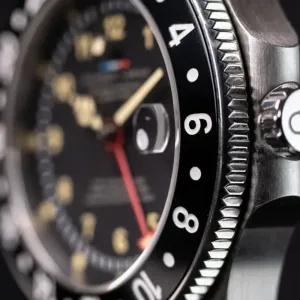
Humbert-Droz HD9 GMT Noir: a French dive watch combining robustness and GMT functionality
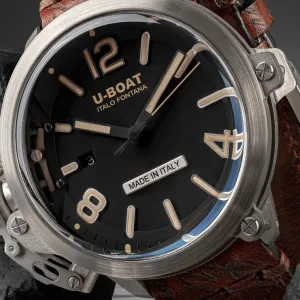
U-BOAT: from Italian military heritage to contemporary dive watches
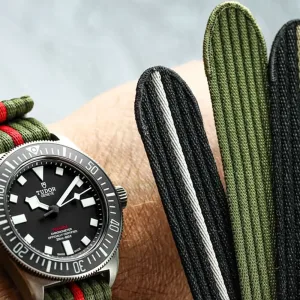
ZULUDIVER 1973 Naval-Marine: a men's textile watch strap inspired by the military world.
Get ready for the next dive! Receive our latest news and inspiration dedicated to military and dive watches.
Subscribe
Editor: Éric Barse
Journalist, entrepreneur, and founder of the websites www.cafe-racer-only.com and www.scooter-3-roues.com, Eric Barse divides his time between his passions: motorcycles, travel, and watches. A graduate of the Saint-Cyr military academy and the 2nd RPIMA (Parachute Regiment) before pursuing a career in communications and digital media, he has a true passion for authentic watches that have accompanied his two-wheeled adventures for many years, from the Indian Ocean to Africa and Latin America!