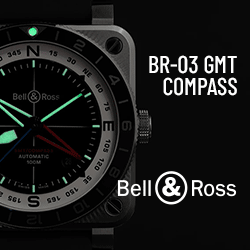

METAS Master Chronometer Certification and military watches
Precision, shock resistance, water resistance, and legibility have traditionally been the primary qualities sought in a military watch. However, another parameter has become particularly relevant with the proliferation of electrical and electronic equipment: resistance to magnetic fields. For a mechanical watch, magnetism can disrupt certain movement components and degrade its accuracy. In technical, industrial, or military environments where electromagnetic sources are numerous, a caliber's ability to continue functioning correctly in the presence of a strong field becomes a crucial characteristic. This is precisely one of the areas covered by METAS's Master Chronometer certification. The protocol does not simply evaluate accuracy: it also covers resistance to magnetic fields reaching 1.5 tesla, or 15,000 gauss, as well as water resistance and power reserve. For a mechanical military watch, and especially in certain naval environments, this resistance offers an advantage that goes far beyond mere marketing.

What is Master Chronometer certification?
METAS is the Swiss Federal Institute of Metrology. Its certification body, METAS-Cert, notably carries out Master Chronometer certification for mechanical watches. The difference between this and a standard chronometer certification is significant. The Master Chronometer protocol focuses on the finished watch and primarily covers four areas: chronometric performance, resistance to magnetic fields, water resistance, and power reserve. To be eligible for certification, the watch must be Swiss Made, and its movement must meet the chronometer criteria of ISO 3159. The process requires that each movement and each watch be tested according to established procedures, under a system controlled by METAS. The institute analyzes the results, performs random sampling checks, and audits the testing equipment. The term Master Chronometer therefore corresponds to a set of verified performance characteristics and is not simply a marketing term.
Master Chronometer and COSC: what's the difference?
COSC and METAS should not be seen as opposing forces: within this certification process, they operate at two complementary levels. Traditional chronometric certification verifies the accuracy of a mechanical movement according to a standardized protocol. The Master Chronometer program goes further by evaluating the finished watch and adding, in particular, resistance to magnetism, water resistance, and power reserve. This difference is especially important for a tool watch. A movement can be extremely precise under normal conditions but become disrupted when exposed to a sufficiently strong magnetic field. The Master Chronometer protocol aims precisely to verify that its performance remains consistent in this environment.
Why does magnetism disrupt a mechanical watch?
A mechanical watch functions thanks to a set of extremely small components. The balance wheel and its hairspring, in particular, play a crucial role in regulating the watch's timekeeping. When certain ferromagnetic components are exposed to a magnetic field, their behavior can be altered. A magnetized balance spring, for example, can have its coils interact differently, resulting in a significant change in its accuracy. The watch can then run fast or slow considerably. This is not an old problem. Long before the advent of smartphones and laptops, certain professions already involved working near electrical machinery or equipment generating magnetic fields. The watchmaking industry has therefore developed various solutions: internal cages made of soft metal to protect the movement or, more recently, components made from materials with little or no sensitivity to magnetism.
15,000 gauss: the threshold for METAS certification
It is on this point that the Master Chronometer certification particularly stands out. METAS requirements concern mechanical movements and watches resistant to a field of 1.5 tesla, or 15,000 gauss. METAS documentation points out that a previous ISO standard for a so-called antimagnetic watch was only 4,800 A/m, or about 60 gauss. The difference is considerable. But the protocol doesn't simply verify that the watch continues to function after being exposed to the field. METAS also measures its chronometric performance. The certification therefore aims to ensure that the watch remains a high-performing timekeeping instrument despite this exposure. For a professional mechanical watch, this is a fundamental difference.
Why might antimagnetism be beneficial in a land-based military environment?
Modern land forces operate in a technological environment vastly different from that in which the first military watches appeared. Vehicles, electrical systems, communication equipment, generators, motors, and various electronic devices can be part of the daily environment for certain specialties. This obviously doesn't mean that a soldier is continuously exposed to 15,000 gauss. The distinction is important: a Master Chronometer certification is not a military certification, and METAS does not claim to replicate all the conditions encountered by armed forces. However, high resistance to magnetism provides an additional safety margin for a mechanical watch likely to be worn in technical environments. This feature can be particularly relevant for personnel working near electrical systems, motors, or equipment that produce significant magnetic fields.


Vehicles and Technical Environments
Military personnel assigned to armored vehicles, maintenance, or certain technical functions may be surrounded by electrical and electromechanical equipment. Alternators, electric motors, power systems, and various onboard equipment all constitute environments where a mechanical watch resistant to magnetism offers a theoretical advantage. The benefit is not necessarily to continuously withstand a 15,000 gauss field. It is to limit the risk that a single exposure will permanently affect the watch's accuracy. For a watch intended to remain a self-contained mechanical instrument, this invisible robustness is at least as important as the scratch resistance of its case.
Why the topic becomes even more relevant in the navy
In the naval environment, magnetism has a very specific operational importance. A ship produces a magnetic signature that can be detected. This signature can be exploited by certain underwater mines. Navies therefore use degaussing systems to reduce the magnetic signature of their vessels. The U.S. Navy describes a degaussing system as a set of coils installed on a ship or submarine to compensate for its magnetic signature. Reducing this signature constitutes a passive countermeasure against the threat of mines. The phenomenon is significant enough that ships can pass over specialized facilities capable of measuring their magnetic signature and verifying the effectiveness of their compensation systems.
Magnetic mines: a historical issue that remains relevant
The exploitation of ships' magnetic fields for military purposes is not new. Magnetic mines use the modification of the surrounding field caused by a ship's passage to help trigger them. As early as World War II, degaussing systems were installed on ships to reduce this vulnerability. The principle remains relevant in modern navies. The U.S. Office of Naval Research explains that contemporary systems aim to reduce a ship's signature sufficiently to complicate its detection by the magnetic sensors used, in particular, in certain underwater weapons. However, a simplistic approach should be avoided: wearing a Master Chronometer watch obviously does not make its wearer undetectable by a magnetic mine. The certification concerns the watch's ability to resist a magnetic field, not the reduction of its own magnetic signature. The two are different subjects, even if they both illustrate the particular importance of magnetism in the naval environment.
Submariners and shipboard personnel
Ships and submarines also concentrate a significant amount of electrical equipment in sometimes confined spaces. For a sailor using a mechanical watch, having a movement that is relatively insensitive to magnetism is therefore a characteristic consistent with this environment. This resistance is all the more valuable because a mechanical military watch retains a fundamental advantage: its operation does not depend on daily recharging or an external power connection. It can thus serve as a standalone timekeeping instrument to complement onboard electronic systems. Here again, METAS certification does not guarantee specific suitability for service aboard a military vessel. It simply provides measurable data regarding the watch's ability to withstand a severe magnetic environment.
Military divers and mine warfare
The topic also deserves attention in the world of military divers, while distinguishing between two concepts. For a mechanical watch used underwater, antimagnetism primarily protects the accuracy of the watch itself. For certain mine warfare operations, controlling the magnetic signature of equipment presents a different and much broader challenge. The U.S. Navy points out that the electromagnetic signatures of ships can enable their detection and contribute to mine-laying. Equipment used near sensitive devices may therefore have specific requirements for a low magnetic signature. However, a watch certified as a Master Chronometer is not automatically antimagnetic or certified for mine clearance. This distinction is essential.
- Antimagnetic here means that the watch resists the influence of a magnetic field.
- Antimagnetic or low magnetic signature refers to the ability of equipment not to generate or significantly disrupt a magnetic field.
A watch can be highly resistant to magnetism without meeting the specific requirements of equipment intended for mine clearance divers.
Verified accuracy on the finished watch
The value of Master Chronometer for a military watch extends beyond magnetism. METAS also verifies the accuracy of the finished watch in various positions and conditions. In the documentation detailing the protocol, daily accuracy is evaluated in six positions and at two temperatures to replicate different wearing conditions. The historical protocol described by METAS mandates a particularly tight average daily rate, between 0 and +5 seconds per day, for the mechanical watch tested under these conditions. The benefit for a professional watch is clear: the certification doesn't just seek excellent performance when the watch remains perfectly still in an ideal position. It examines its behavior in different orientations, more closely reflecting the variations encountered on the wrist.
Water resistance, another relevant criterion for a military watch
METAS also verifies the water resistance claimed by the manufacturer as part of the Master Chronometer protocol. For a land-based military watch, this feature provides protection against rain, humidity, or accidental immersion, depending on the claimed water resistance level. For a watch intended for a naval environment, it obviously becomes even more important. However, Master Chronometer should not be confused with a diving watch certification. A true diver's watch must meet other criteria, particularly regarding its dive time measurement system and legibility.
Power reserve is also verified.
A mechanical watch may advertise a 60, 70, or 80-hour power reserve. However, this value must correspond to the actual performance of the movement. Power reserve is one of the characteristics checked in the Master Chronometer program. In a professional context, the benefit is tangible. A significant power reserve, for example, allows you to leave a watch for a specific period and find it still running. For a self-powered mechanical instrument, this endurance directly contributes to its ease of use.
Is a Master Chronometer watch a military watch?
No. This is probably the most important distinction to remember. The Master Chronometer certification is not a military approval. It does not mean that a watch has been adopted by a military, tested in combat, or qualified according to the specifications of a particular unit. Nor does it, on its own, guarantee shock resistance, luminescence quality, lug strength, or ergonomics with gloves. However, it does certify properties that can be particularly relevant for a watch intended for military use: accuracy, resistance to magnetism, water resistance, and power reserve.
Antimagnetism: invisible but essential protection
Magnetic resistance has a unique characteristic compared to the immediately visible features of a watch. A ceramic bezel, a reinforced case, or a sapphire crystal can easily be highlighted. A movement's resistance to magnetism is practically invisible. Yet, magnetization can transform a perfectly regulated mechanical watch into a much less precise instrument without causing any apparent external damage. For a military or professional watch, this ability to maintain a stable rate in the face of an electromagnetic environment therefore constitutes a form of robustness in its own right.
Master Chronometer Certification: What Does METAS Certify?
| Tested Criterion | Requirement / Principle | Benefit for a Military Watch |
|---|---|---|
| Chronometric accuracy | Rate performance tested in different positions and conditions | Helps maintain accurate timekeeping during daily and professional use |
| Magnetic resistance | Movement and complete watch tested up to 15,000 gauss (1.5 tesla) | Particularly relevant around electrical and electronic equipment, motors and technical installations |
| Accuracy after magnetic exposure | Testing does not simply verify that the watch continues to run; its chronometric performance is also assessed | Reduces the risk of magnetic exposure causing significant timekeeping errors |
| Water resistance | Verification of the water-resistance rating claimed for the watch | Important in wet and naval environments and, depending on the specifications of the watch, for diving |
| Power reserve | Verification of the power reserve claimed by the manufacturer | Confirms the actual autonomy of the mechanical movement |
| Complete watch testing | Requirements apply to the complete mechanical watch, not only to an uncased movement | Provides a more representative assessment of the performance of the watch as actually worn |
| ISO 3159 Chronometer | The movement must first meet the ISO 3159 requirements for a chronometer | Provides a standardized chronometric foundation in addition to the other METAS tests |
| Swiss Made | The watch must meet the “Swiss Made” conditions required for certification | A prerequisite for certification, although not a military performance criterion in itself |
| Independent control | METAS supervises the testing procedures, analyses results and performs sampling inspections | Provides independent verification of the claimed performance |
Master Chronometer: particularly well-suited to the modern military watch
The first military watches met a few fundamental requirements: telling time quickly, withstanding field conditions, and operating independently of any infrastructure. A century later, these principles remain relevant, but the technological landscape has changed dramatically. The contemporary mechanical watch can operate alongside communication systems, electric motors, electronic equipment, and naval installations where magnetism presents a very real technical challenge. In this context, METAS's Master Chronometer certification offers a particularly valuable solution. While resistance up to 15,000 gauss is not a military certification, it guarantees that a mechanical watch has been designed and tested to continue functioning accurately in the face of very strong magnetic fields. For land-based personnel working in certain technical environments, this feature represents an additional layer of protection. In the naval world, where mastering magnetism is a historical and ongoing challenge—even extending to reducing the magnetic signature of ships and submarines against mines—it takes on a special significance. A Master Chronometer military watch, therefore, does not become combat equipment simply by virtue of its certification. However, for those seeking a precise, waterproof, self-powered mechanical watch with high resistance to magnetism, the METAS protocol provides objective guarantees that are particularly consistent with the requirements of a true tool watch.
More…
COSC certification: what does it guarantee for a diving or military watch?

Onion crown: the military legacy of a detail that has become iconic
Casio military watch: how the brand became a global benchmark in the armed forces

Watch restoration: precision and technology
Get ready for the next dive! Receive our latest news and inspiration dedicated to military and dive watches.
Subscribe
Editor: Éric Barse
Journalist, entrepreneur, and founder of the websites www.cafe-racer-only.com and www.scooter-3-roues.com, Eric Barse divides his time between his passions: motorcycles, travel, and watches. A graduate of the Saint-Cyr military academy and the 2nd RPIMA (Parachute Regiment) before pursuing a career in communications and digital media, he has a true passion for authentic watches that have accompanied his two-wheeled adventures for many years, from the Indian Ocean to Africa and Latin America!