
Military paracord bracelet: from parachute suspension line to soldiers' wrists
Nowadays, you need only look for tactical gear to come across it. Braided—usually in olive drab, black, or tan—secured by a buckle, and substantial enough to be instantly recognizable, the military paracord bracelet has become one of the most iconic accessories in the survivalist world. It can be found in outdoor shops, on the wrists of hikers, and sometimes paired with military watches. Yet, long before it became an accessory, paracord served a far more serious purpose: connecting a paratrooper to the canopy that would save his life. Its story began with World War II airborne gear and continued in the field, where soldiers quickly discovered that a parachute suspension line could be put to many other uses. The bracelet came later. It turned an incredibly simple concept into a tangible object: since a length of cord could prove indispensable, why not wear several meters of it right on your wrist?

Before the bracelet, there was the parachute
The term "paracord" is a contraction of "parachute cord." It was developed as a lightweight cord intended primarily for the suspension lines of American parachutes during World War II. The use of nylon was a key factor: this synthetic fiber allowed for the production of a cord that was strong, relatively elastic, and lightweight—ideal for the demands of military parachuting. However, once on the ground, paratroopers quickly discovered that the cord possessed a quality essential to a soldier: it could be used for almost anything. The USO reports that men would salvage the cords from their parachutes after use to carry with them. It could be used to secure gear, make improvised repairs, replace shoelaces, set up a shelter, or meet various needs in the field. The suspension line had moved from the sky to become a piece of military utility cord. It is this "second life" that largely explains the fascination paracord still holds today. It did not originate as a survival gadget; it became versatile because soldiers facing very real, practical challenges began repurposing a piece of their standard-issue gear.
Why is it called "550 cord"?
In US military parlance, the term "550 cord" has become almost as common as "paracord." The number is not merely for show; it refers to the minimum breaking strength of Type III paracord: 550 pounds—or approximately 250 kilogram-force—under the conditions defined by the specification. Its construction accounts for part of this strength. A genuine Type III military paracord meeting the MIL-C-5040H specification features a braided sheath surrounding a core made up of multiple strands. In the Type III configuration commonly associated with "550 cord," there are seven inner core strands, each consisting of three twisted yarns in the military version. This design offers the key advantage of providing not only the full cord but also much finer strands when the situation demands them. This distinction is important today. Not all cords sold under the trade name "paracord 550" necessarily meet military specifications. The MIL-C-5040H standard defines the materials, construction, and requirements for cord intended for this use. Consequently, a cord inspired by "550 cord" and a genuine Mil-Spec cord are not automatically the same thing.
One cord, dozens of field uses
Paracord embodies a military principle as old as personal gear itself: carrying something lightweight that can solve multiple problems. A piece of cord might seem rudimentary compared to a modern soldier's high-tech equipment, yet its simplicity is precisely its strength. Securing gear, temporarily replacing a shoelace, repairing a strap, reinforcing equipment, hanging objects, or setting up an improvised shelter—the cord can be adapted to the situation rather than being limited to a single function. The inner strands further expand the possibilities when a finer cord is needed. The USO also notes its historical use by the military for numerous field and survival tasks. However, one must be wary of modern accounts that portray paracord as a universal solution. Its strength does not mean it can replace any piece of safety equipment. Notably, Mil-Spec paracord is not climbing rope, and its breaking strength should not be confused with a certification for securing a person at heights.


But when did military personnel start wearing it as a bracelet?
This is where the story becomes less clear-cut. It is often said that the paracord bracelet originated directly with American paratroopers during World War II. The image is appealing: a GI salvaging his parachute suspension lines, braiding them around his wrist, and inventing the survival bracelet. However, solid historical evidence establishing this exact lineage is far harder to come by than the legend suggests. What can be stated with greater certainty is that paracord was indeed salvaged and repurposed by the military as early as World War II, remaining a staple utility cord in the American military environment. Wearing it as a braided bracelet subsequently emerged as a particularly ingenious way to keep a length of cord on one's person. The concept is nearly perfect: instead of coiling several meters of cord at the bottom of a pocket or pack, it is compacted through knotting and worn on the wrist. If the need arises, the bracelet can be unraveled to retrieve the cord.
The survival bracelet: several meters of cord on the wrist
The most familiar version features a compact braid, often known today as the "Cobra" stitch. The paracord weaves around two central strands to form the thick band that has become the signature look of the survival bracelet. The actual amount of cord available varies, of course, depending on wrist size, the type of braid, and the bracelet's construction. The USO, for instance, mentions military bracelets made with about 10 feet—just over three meters—of paracord. The idea, then, is not to carry an enormous amount of cord, but to keep a few meters of versatile material on hand at all times without taking up pocket space. And unlike gear stowed in a pack, the bracelet typically stays with its owner. It is precisely this constant availability that has cemented its reputation as a piece of emergency gear. From survival gear to a symbol of camaraderie
From survival gear to a symbol of camaraderie
The paracord bracelet, however, has a dimension rarely highlighted in tactical gear catalogs. For some military personnel, it is worn for more than just having a ready supply of cord. The USO (United Service Organizations) has documented service members making "550 cord" bracelets at its centers. Some are crafted among comrades, given as gifts, or kept as mementos of a deployment. They can represent a unit, a bond between soldiers, or the memory of a fallen comrade. This aspect completely transforms the object; the bracelet is no longer merely a potential survival tool. The time spent braiding it, the person who made it, and the circumstances under which it was worn can imbue it with significant personal value. Notably, the USO shares the story of a volunteer who received a bracelet from a soldier who had worn it during patrols from a forward operating base in Afghanistan. Covered in so much dust that its colors were barely distinguishable, the bracelet was given to her as a good-luck charm. It is hard to imagine anything further removed from a mere fashion accessory.
Afghanistan and Iraq: paracord on the modern soldier's wrist
Contemporary conflicts have played a major role in bringing the paracord bracelet to public attention beyond military circles. In U.S. operational environments, 550 cord is a familiar material used for securing items, making repairs, or improvising solutions. Consequently, throughout the 2000s and 2010s, the bracelet became naturally linked to the imagery of troops deployed in Iraq and Afghanistan. USO centers even organized activities where service members could braid their own bracelets, experimenting with various colors, clasps, and knotting techniques. This visibility gradually helped the object transcend the strictly military sphere.
When the military bracelet becomes a survivalist accessory
Once the outdoor community embraced the concept, it became unstoppable. Hikers, bushcraft enthusiasts, survivalists, and fans of tactical gear all adopted the paracord bracelet. Manufacturers expanded the range of colors, braiding patterns, and closure systems. Some modern models have taken the "survival kit on the wrist" concept to the extreme; the buckle might incorporate a whistle, a fire starter, a small compass, or other accessories. What began as a simple design—a few meters of cord braided around the wrist—has evolved into a distinct commercial category. The paradox is fascinating: a material originally created for military parachutes became a fashion item precisely because of its reputation as practical, utilitarian gear.
And why does paracord pair so well with a military watch?
There is an obvious visual affinity between a military watch and a paracord bracelet. Both belong to the same realm of imagery: gear worn directly on the body, designed to remain accessible when the going gets tough. This pairing makes even more sense given that military watches have long fostered a culture of functional straps. From canvas and nylon to NATO-style bands and straps designed to fit over a flight suit, the military watch strap has historically been far more than a mere decorative element. Paracord takes this philosophy a step further. It isn't necessarily used to secure the watch itself; worn alongside it, the bracelet serves as a small, immediately available reserve of raw material. A military diver’s watch on a fabric strap and a 550-cord bracelet may not tell the exact same story, but they speak the same language—that of simple, rugged objects designed first and foremost for utility.
From military nylon to cultural phenomenon
The story of the military paracord bracelet is ultimately one of successive adaptations. Nylon emerged as a strategic material. Cordage originally intended for parachutes evolved into a versatile utility rope; military personnel realized it could solve a multitude of problems in the field. The cord was then braided so it could be worn directly on the wrist. Finally, the bracelet gradually moved beyond military bases into the worlds of bushcraft, survivalism, outdoor activities, and fashion. A distinction must therefore be made between the well-documented history of military paracord and the origins of the paracord bracelet itself, which are harder to pinpoint. This nuance ultimately makes the story more compelling. The bracelet was not a spectacular military invention created on a specific date; rather, it appears to be the natural outcome of decades spent using and repurposing a material that soldiers had come to view as too valuable to discard along with their parachutes. Today, a braided bracelet sold as a tactical accessory might seem far removed from the paratroopers of World War II. Yet, simply uncoil its few meters of cord, and its origins immediately resurface. Underlying the accessory is a deeply military concept: when every gram of gear counts, whatever you carry must serve a purpose.
More…
Discover the Bremont Altitude MB Meteor Stealth Grey, a titanium pilot's watch inspired by military aviation.
Promaster JP2000-08E: the re-release of the watch worn by Jean Reno in The Big Blue
ZRC MN64 Titanium World Record: a diving watch born at -145 meters
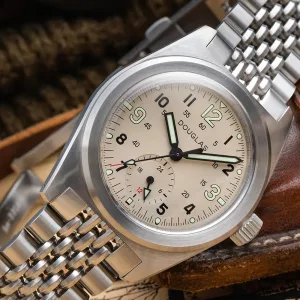
Wolbrook Outrider Professional Mecaquartz: french-style military field watch
Get ready for the next dive! Receive our latest news and inspiration dedicated to military and dive watches.
Subscribe
Editor: Éric Barse
Journalist, entrepreneur, and founder of the websites www.cafe-racer-only.com and www.scooter-3-roues.com, Eric Barse divides his time between his passions: motorcycles, travel, and watches. A graduate of the Saint-Cyr military academy and the 2nd RPIMA (Parachute Regiment) before pursuing a career in communications and digital media, he has a true passion for authentic watches that have accompanied his two-wheeled adventures for many years, from the Indian Ocean to Africa and Latin America!