
IWC and the Navy and Marine Corps air units: squadron watches engraved and finished in Pantone ceramics
Among watchmakers claiming a link to military aviation, IWC holds a position apart. According to the Schaffhausen manufacturer, it is the only licensed maker of watches for every air unit of the US Navy and US Marine Corps, namely 247 active and 100 inactive squadrons. Behind this often-repeated figure lies something more interesting: squadron watches sold only to current and former members, engraved with their name and call sign, then released in civilian series with limited annual production. Since the first TOP GUN in 2007, the relationship has also produced a palette of coloured ceramics codified with Pantone, each shade referring to a training ground or a piece of naval aviation kit.

A licence that US naval aviation grants only to IWC
The figure comes up in every presentation from the brand: according to IWC, no other watchmaker holds a licence to work on watches for the entire air units of the US Navy and US Marine Corps, namely 247 active and 100 inactive squadrons. The specialist press, which relays the manufacturer's own communications, dates this extension to 2018. These figures come from the brand itself, with no independent military confirmation, but the relationship goes far beyond a logo stamped on a dial. It rests on an ongoing dialogue with aircrews, which Christoph Grainger-Herr, CEO of IWC, describes as a privilege for his engineers and designers: exchanging with elite pilots who put the watches to the test every day in the cockpit. The Professional Pilot's Watches Program extends this approach to professional pilots, for whom IWC has already created more than two dozen bespoke pieces.
From TOPGUN to a full line, a lineage opened in 2007
It all starts with naval aviation's most famous school. Founded in 1969, the TOPGUN programme trains selected pilots so they can return to their units as instructors. IWC became its official licensee in 2007 and released its first TOP GUN that year, pairing a double split-seconds chronograph with a black zirconium oxide ceramic case. The material was no accident: the manufacturer states it presented the first watch case in this dark zirconia as early as 1986, before introducing it on its pilot's watches in 1994. In 2012, TOP GUN stopped being a simple edition and became a line in its own right, launched with five new models. What remained was the next step: moving from the weapons school to the squadrons themselves.
Squadron watches engraved with name and call sign
The heart of the scheme lies in a category of watches the general public almost never encounters. Squadron pieces are reserved for current and former members of the unit concerned, and each one receives an individual engraving with its owner's name and call sign. In 2018, TOPGUN graduates thus had access to two models: the Mark XVIII Edition ‘Strike Fighter Tactics Instructor’ and an Edition ‘SFTI’ Chronograph. The following year, for the 50th anniversary of the Navy Fighter Weapons School, IWC designed with the instructors of NAS Fallon, Nevada, a chronograph never put on sale, highlighted in sky blue, a colour worn only by TOPGUN instructors. For the Marines, the first collaboration produced a Mark XVIII marked with the ‘Bats’ insignia at 9 o'clock, with a yellow date window. As for the Blue Angels, of whom IWC became licensee in 2019, their 75th anniversary brought a piece bearing the staff crest, also reserved for the team.
Discover the full specifications of the IWC Montre d’Aviateur Timezoner TOP GUN


Four Pantone shades drawn from naval aviators' daily life
The partnership struck with Pantone in 2021 gave rise to the ‘Colors of TOP GUN’ collection. Rather than opening the range to coloured ceramics, it marked a tidying up: the Mojave Desert beige already existed, and the blue Blue Angels model dates from the same year. Four shades thus emerged, Lake Tahoe, Woodland, Mojave Desert and Jet Black, with Pantone's tools allowing dial and strap to be matched to the case. Each refers to a specific setting. The white Lake Tahoe evokes the winters at the lake where SFTI programme aviators train nearby. The green Woodland picks up the shade of naval aviation flight suits. The beige Mojave Desert refers to Naval Air Weapons Station China Lake, the Navy's largest land holding, and to the suits worn by some of TOPGUN's ‘adversary’ pilots. The matte black Jet Black cites the coatings of modern fighter jets.
Ceramic and Ceratanium, materials dictated by the carrier
IWC justifies its choices by shipboard life: night landings, heavy G-loads on the F/A-18E/F Super Hornet, and salt-laden sea air. A ceramic case shrinks by around a third during firing, something that must be anticipated at the design stage. Ceratanium is a titanium heated after machining, whose surface, enriched by oxygen diffusing into the metal, approaches ceramic without a coating liable to chip. TOP GUN watches retain a soft-iron inner cage against magnetism, a solution developed in 1948 for the Royal Air Force's Mark 11, and a fixed crystal designed to hold in case of sudden depressurisation. Unveiled at Watches and Wonders 2022 after a Geneva preview in August 2021, the Lake Tahoe and Woodland chronographs measure 44.5 x 15.7 mm, house the in-house calibre 69380, are water-resistant to 60 m and are produced in runs of 1,000 pieces a year each. The Woodland, whose pushers, crown and caseback are in Ceratanium, launched at CHF 10,900, against CHF 9,900 for the Lake Tahoe.
Can you wear an IWC squadron watch without being a naval aviator?
Engraved pieces never leave the squadron circle, but IWC has built a bridge. The civilian version of the chronograph reserved for TOPGUN graduates, sold under the name SFTI, was produced in 1,500 pieces in black ceramic, 44 mm, with caseback and pushers in Ceratanium. In 2021 came three squadron-inspired chronographs, Royal Maces, Tophatters and Blue Angels, each limited to 500 pieces a year: a first for buyers who are not pilots, according to the press. The Tophatters of VFA-14, formed in 1919 and based at NAS Lemoore, California, are said to be the Navy's oldest active squadron. The Royal Maces of VFA-27, a Navy squadron attached to Carrier Air Wing 5, are stationed at Marine Corps Air Station Iwakuni, Japan. The list of partner units runs well beyond these, from the Diamondbacks of VFA-102 to the Fighting Redcocks of VFA-22, through to the Death Rattlers of VMFA-323 among the Marines.
IWC and US naval aviation: when the watch becomes a squadron insignia!
The relationship between IWC and American carrier aviation says something about the evolution of the military watch. It is no longer merely an instrument there: engraved with a call sign, stamped with a crest, tinted in the colour of a flight suit or a training desert, it functions as a mark of belonging, much like a patch sewn onto a sleeve. The pilots who wear it in flight feed the work of Schaffhausen's engineers, while the civilian series let enthusiasts approach this world without usurping its marks: the engraved version remains the preserve of those who served. This boundary is what gives the whole its value. It also explains why the figure of 247 squadrons matters less than what it represents: a Swiss manufacturer listening to shipboard crews, and watches that only members of a unit can wear under their own name.
More…
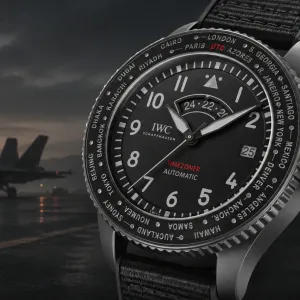
IWC Timezoner TOP GUN Ceratanium: three stories united in a black pilot’s watch
HGP Diver 200M Chrono-Mecaquartz: the first chronograph from the Hommes-Grenouilles de Paris
REC Vulcan XH558: a watch cut from the last Vulcan bomber ever to fly
AVI-8 Bell X-1 Machbuster: from the limited Glamorous Glennis series to the production pilot's watch
Get ready for the next dive! Receive our latest news and inspiration dedicated to military and dive watches.
Subscribe
Editor: Éric Barse
Journalist, entrepreneur, and founder of the websites www.cafe-racer-only.com and www.scooter-3-roues.com, Eric Barse divides his time between his passions: motorcycles, travel, and watches. A graduate of the Saint-Cyr military academy and the 2nd RPIMA (Parachute Regiment) before pursuing a career in communications and digital media, he has a true passion for authentic watches that have accompanied his two-wheeled adventures for many years, from the Indian Ocean to Africa and Latin America!