
ZRC Securicode Bronze Limited Edition: a bronze diver that inherits the Marine nationale's legacy
For its 120th anniversary, the Geneva house ZRC launched the Securicode collection, three vintage-styled divers offered in different materials. The most distinctive is the Bronze Limited Edition, reference SC39463: a 39 mm CuSn8 bronze case, a run of 200 pieces and a style borrowed from the 1959 S1, the first prototype of the Grands Fonds designed in response to a tender launched by the Marine nationale. Behind its retro look, the watch uses an uncommon technique, the programmed-deformation caseback, whose water resistance increases as pressure rises. Guaranteed to 300 m and powered by a Sellita SW200-1 Élaboré, it is priced at CHF 3,290 including tax.

ZRC, a Geneva house that moved from bracelets to the deep sea
Before signing its name to dive watches, ZRC built its reputation in watch case making. Founded in Geneva in 1904 on the initiative of Edmond Zuccolo and Joseph Rochet, the house received registration no. 52 in the Geneva trade register in 1909. At the time it made chains and bracelets, a field in which it won the Industrie Nouvelle diploma in 1917 for the first expandable bracelet. The workshop then turned to waterproof cases, which it made on behalf of other brands. This expertise in casing, more discreet than that of movements or dials, formed the foundation on which the house would build its reputation in professional diving, once the Marine nationale entered the picture in the late 1950s.
1958, the tender that gave birth to the Grands Fonds
It all began with a tip-off. In 1958, Yves Pastre, watchmaker for the Navy, informed ZRC that the Marine nationale had just launched a tender. Louis Brunet, then director, seized the opportunity and launched the Grands Fonds project. The S1 prototype was presented as early as 1959. It stemmed from a study conducted for firefighter-divers working on Lake Annecy, was fitted with a Felsa 4000 movement, placed its crown at 3 o’clock and already carried Magnum hands. It is this first state of the Grands Fonds, predating the modifications requested by the military, that the bronze Securicode chooses to revive, down to the position of its crown.
From the G.R.S. to the Hubert commando unit, a watch put to the test
The watch then passed through the hands of the G.R.S. of the Marine nationale, before being adopted. The brand's own pages disagree on the timeline, one mentioning approval in 1960, the other trials conducted from May to November 1961: the early 1960s is the safest marker. This first Grands Fonds accompanied Navy divers until 1966. The field, however, revealed a weakness, as the crown at 3 o’clock was judged too exposed underwater. ZRC responded with the Grands Fonds 300, which moved the crown to 6 o’clock on an amagnetic monobloc case. The Grands Fonds equipped the diving school, the mine-clearance diver groups and the Hubert commando unit, and the house supplied mine-clearance divers until 1995.
The 1965 Securicode, a name born from an invention
The question of the name remains. The original Securicode was born in 1965 and featured a central calculator that could determine in advance the possible immersion time according to depth, an innovation crowned with the first prize at the 11th Brussels Inventors' Fair. The current collection blurs the lines somewhat: ZRC celebrates “65 years of Securicode” while also referencing an original 1959 model, which ties the name back to the S1. To be precise, then, the newcomer borrows its style from the 1959 S1 and its name from the 1965 Securicode, though it does not reprise the latter's calculator.


A programmed-deformation caseback, modelled on submarine airlocks
Beneath its retro look, the bronze Securicode retains the construction that sets ZRC apart. With programmed deformation, water resistance no longer depends on how tightly the caseback is screwed down: pressure on the gasket increases with external pressure. The caseback combines two parts, a clamping ring and a protected, thread-free back, following the principle of a submarine airlock. Georges Brunet, the house's CEO, came up with the idea while observing the watertightness of airlocks during a Red Sea exercise aboard the nuclear submarine La Perle. Thanks to this, ZRC claims 5,100 m in titanium and 1,000 m in steel, without a helium valve or gel inside the case. Here, the watch is guaranteed to 300 m and tested to 800 m.
CuSn8 bronze over a steel caseback
The 39 mm CuSn8 bronze case, with a brushed finish, measures 13.4 mm thick for a 48 mm lug-to-lug. Its screw-down caseback is made of stainless steel, keeping the bronze away from the skin. The screw-down crown remains at 3 o’clock, true to the S1. The unidirectional notched rotating bezel has 60 divisions, but the material of its insert remains uncertain: the brand variously mentions ceramic or steel, while other sources refer to black ceramic. The 2.9 mm domed sapphire crystal has a blue anti-reflective coating, and magnetic resistance reaches 4,800 A/m per ISO 764.
Guilloché dial and Sellita SW200-1 Élaboré
The black dial, in double-thickness guilloché brass, carries gilt hour markers and markings on this version, along with an ‘eggshell’-tinted beige lume. The Magnum hands inherited from the S1 accompany a lollipop-style seconds hand in Super-LumiNova, and the date window at 3 o’clock matches the dial colour. The movement is a Sellita SW200-1 in Élaboré grade: 4 Hz, or 28,800 vibrations per hour, maximum amplitude of 315°, 38-hour power reserve, 26 jewels, hacking seconds and regulated in three positions to ±7 s/day. It displays hours, minutes, seconds and date. The 18 mm strap, patinated and stitched in off-white, closes with a steel pin buckle. The leather's material remains uncertain, variously described as vegetable-tanned or calfskin depending on the source.
A place apart in the Securicode range
Within the collection, the bronze version sits alongside the Diver300 Metal SC39163 (CHF 2,490), the Securicode Diver300 SC39208 (CHF 2,690) and the Diver300 Rubber (CHF 2,790). With its run of 200 pieces priced at CHF 3,290 including tax, it is only outranked by the Torch Limited Edition, another bronze Securicode limited to 50 pieces and sold for CHF 3,490, in tribute to the submarine Le Tonnant and to Operation Torch of 1942. ZRC presents the Securicode as more understated than the Grands Fonds, intended for urban chic use, delivered in a vintage box with a dedicated cap.
ZRC Securicode Bronze Limited Edition: a diver that hasn’t forgotten its military origins!
The bronze and the vintage register could reduce this Securicode to a purely decorative object. That would overlook the fact that its design is that of an instrument born from a military specification, and that its imperfections are part of the story: the crown at 3 o’clock, which the Navy found too exposed, is kept here by choice, like a signature of the very first Grands Fonds. Preferring the prototype over the finished version says a great deal about how houses linked to the armed forces revisit their past: less to reproduce its efficiency than to capture its founding moment. The watch nonetheless retains a genuine technical distinctiveness, since few cases of this size entrust their water resistance to the pressure of the water itself. As for the wavering dates and materials in the brand's communication, they are a reminder that a legacy is only well passed on when it is told with precision.
More…
XT1 Charlie Toor folding knife: from Alpha to Charlie, the evolution of a frame lock built for the field
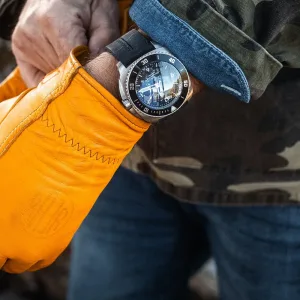
Ralf Tech WRX Electric Original: a week on the wrist of the combat divers' watch

Apollo 11 watch: the Omega Speedmaster, the issued watch that walked on the Moon
Military watch: why the watch handed to every soldier has all but disappeared from the armed forces
Get ready for the next dive! Receive our latest news and inspiration dedicated to military and dive watches.
Subscribe
Editor: Éric Barse
Journalist, entrepreneur, and founder of the websites www.cafe-racer-only.com and www.scooter-3-roues.com, Eric Barse divides his time between his passions: motorcycles, travel, and watches. A graduate of the Saint-Cyr military academy and the 2nd RPIMA (Parachute Regiment) before pursuing a career in communications and digital media, he has a true passion for authentic watches that have accompanied his two-wheeled adventures for many years, from the Indian Ocean to Africa and Latin America!