
Relwen Camo Shirt Jacket: from Marine frog skin camouflage to quilted flannel
Long offered in tartans and checks, Relwen's Quilted Flannel Shirt Jacket, from a brand founded in Ohio, now comes in a print that speaks directly to military gear enthusiasts: Duck Camo. Behind this hunting name lies a precise lineage, that of the M1942 ‘frog skin’ camouflage, designed during the Second World War and worn by Marines in the Pacific before ending up in surplus stores, then in marshes. The shirt jacket carries this pattern on brushed cotton flannel, quilted with recycled batting. It stays compact enough to wear as a shirt and insulated enough to serve as a lightweight jacket in between seasons. It sells for $258, around €220.

Duck Camo, a print born on the battlefields of the Pacific
Relwen offers its Quilted Flannel Shirt Jacket season after season, almost always in tartans and checks evoking a workwear wardrobe. The arrival of a Duck Camo colourway changes how the garment reads. This camouflage, readily associated with duck blinds beside ponds, was not invented for hunting: it is the direct descendant of a 1942 military pattern that passed through several conflicts and through surplus stocks before becoming a civilian classic.
Norvell Gillespie and the frog skin of the Marine Raiders
The original pattern is the M1942 ‘frog skin’, and its creator came from a world far removed from arsenals. Norvell Gillespie was a civilian horticulturist and gardening editor at Better Homes & Gardens magazine. His design represents the US Army's first attempt at camouflage through disruptive colouring, that is, patches that break up the silhouette instead of blending it into a solid colour. The first to be issued it were the Marine Raiders, in 1942, in the Pacific. The uniforms were cut from herringbone twill, the famous HBT, and above all reversible: a five-colour jungle side, a three-colour beach side, to accompany the fighter from vegetation to shoreline. Some Army units also wore it in Normandy in the summer of 1944.
From surplus stocks to hunters' marshes
Production stopped in January 1944. The remaining uniforms went into surplus, where they found an unexpected clientele: hunters, who adopted these outfits and gave the pattern the nickname that stuck, duck hunter. Yet the design's military career did not end there. It turns up on Marine helmet covers in Korea, issued to the 1st and 2nd Foreign Parachute Regiments during the Indochina War, worn by Brigade 2506 during the Bay of Pigs landing, then in Vietnam by SEALs, Rangers and Montagnards for lack of regulation camouflage uniforms. At the same time, civilian manufacturers reproduced it for hunting from the 1960s through to the 1990s, extending its life well beyond the arsenals.
Relwen, Ohio and the military wardrobe
This pattern finds natural ground at Relwen. The brand was founded in October 2007 in Bexley, Ohio, by Jamie Rupp, whose parents already worked in apparel. From the start, it claimed inspiration drawn from the most honest aspects of military and workwear, rooted in the farms and fields of Ohio and Michigan. The house motto, “Be Lasting”, sums up the ambition: pieces made to endure. Snaps presented as military-grade and vintage-inspired finishes recur across the whole collection, which has become one of Huckberry's bestsellers. The recent Defender, a 2-in-1 jacket inspired by the M65 with a removable quilted liner, confirms this lineage.


Three layers assembled as a single fabric
Construction is the real technical point of this shirt jacket. The outer shell is a 190g/m² 100% brushed cotton flannel, woven in twill, slightly denser than the 180g/m² stated for an earlier version of the model. Underneath, 80 grams of 100% recycled polyester batting provides insulation, while a polyester ripstop lining closes the assembly, box-stitched through the insulation. These three layers are quilted together, then cut and sewn as a single piece. There is therefore no floating lining: the garment stays flat and compact, which allows it to move from the role of shirt to that of jacket. The brand even suggests wearing it as a reinforced shirt, tucked in at the front. Inside, the seams are bound for a clean finish.
Black snaps and five pockets
The hardware stays understated. The front, cuffs and chest pockets close with black oxidised metal snap fasteners, a choice that suits the pattern, with nothing shiny to stand out against the camouflage. The jacket has five pockets in total. The two chest pockets close with snaps. Two hand-warmer pockets are hidden in the side seams and are lined with brushed knit, a welcome detail in cool weather. Finally, a large zipped interior pocket, placed at chest height, keeps safe what one would rather not leave in an open pocket.
A generously cut mid-season piece
Its range of use is clear. The stated range runs from 35 to 50 degrees, almost certainly Fahrenheit, or roughly 2 to 10°C: this is a transitional-season layer, not a parka. Relwen calls the fit classic, though one retailer judges it fairly roomy. Chest measurement is around 109cm in S and 135cm in XXL, with the thickness of the material removing roughly 2.5cm of usable volume. Sizing is considered true to size: buyers are advised to choose their usual jacket size, or size up if torn between two. The range runs from S to XXL, and this season Duck Camo sits alongside three tartans, Green Multi Plaid, White Multi Plaid and Dark Grey/Navy Plaid. The garment is manufactured outside the United States.
How do you care for a quilted flannel shirt jacket?
The combination of cotton and recycled polyester simplifies care. The jacket is machine washable in cold water, without bleach, then air-dried or tumble-dried on low heat. Ironing should be avoided, which makes sense: the box quilting has nothing to gain from a hot iron. These simple instructions help preserve a piece that sells for $258, around €220, and is designed to last through several seasons.
Relwen Camo Shirt Jacket: when a 1942 camouflage returns in flannel
Few prints have followed as winding a path as the duck hunter pattern. Designed by a horticulturist to clothe fighters in the jungle, it travelled through the Pacific, Normandy, Indochina and Vietnam before equipping hunters who found it on the surplus rack. Finding it again on a quilted shirt jacket says something about how the military world now feeds into civilian wardrobes today: less a disguise than a memory one wears. Relwen is not trying to reproduce a uniform. The brand borrows a proven visual language and applies it to a mid-season garment designed for everyday use, worn as a shirt as much as a jacket. This is often how military heritage survives best, through details that have proven themselves and patterns whose history reaches far beyond fashion. The 1942 camouflage no longer has anything to hide, it now has a great deal to tell.
More…
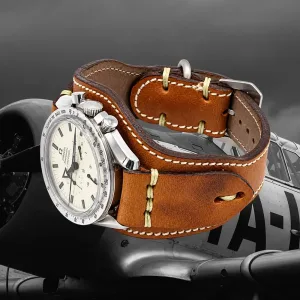
Nato Vintage Style Monopezzo military watch strap: the military one-piece reimagined in Roman leather
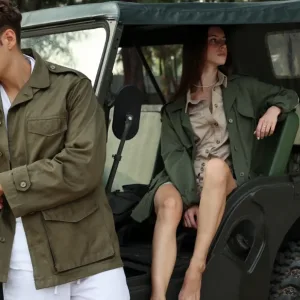
Coulange military safari jacket: from colonial uniform to casual wardrobe, the legacy of the M47
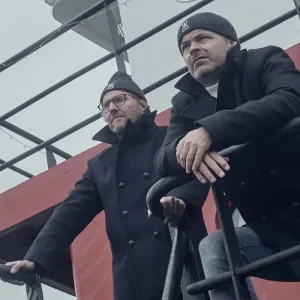
Saint James naval officer's peacoat: the timeless elegance of a French military garment
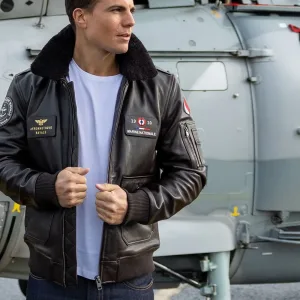
Daytona 73 leather jacket: Aéronautique navale celebrates 400 years of the French Navy
Get ready for the next dive! Receive our latest news and inspiration dedicated to military and dive watches.
Subscribe
Editor: Éric Barse
Journalist, entrepreneur, and founder of the websites www.cafe-racer-only.com and www.scooter-3-roues.com, Eric Barse divides his time between his passions: motorcycles, travel, and watches. A graduate of the Saint-Cyr military academy and the 2nd RPIMA (Parachute Regiment) before pursuing a career in communications and digital media, he has a true passion for authentic watches that have accompanied his two-wheeled adventures for many years, from the Indian Ocean to Africa and Latin America!