
Panerai Submersible Elux LAB-ID: the return to the wrist of a light born for the Marina Militare
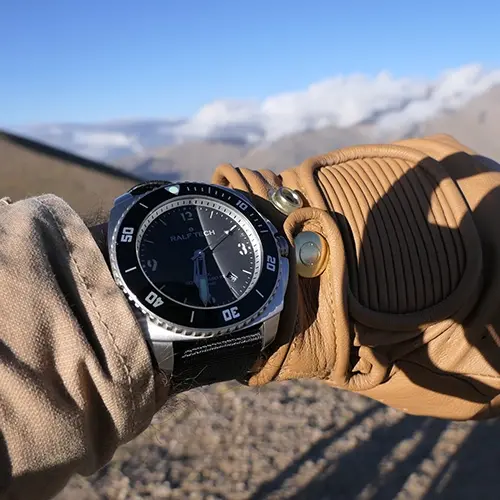
Panerai’s history is first and foremost one of an obsession: making the time legible in the dark. With the Submersible Elux LAB-ID, reference PAM01800, the manufacture offers an unprecedented answer to this old diver’s concern. Its fully mechanical calibre converts the energy of four barrels into electricity via a microgenerator, which powers on demand 160 micro-LEDs spread across the hour markers, hands and bezel graduation. The name revives a technology patented in 1966 to illuminate the Marina Militare’s instruments. A concept watch limited to 150 pieces over three years, it also imposes its own limits: a 49mm diameter, half an hour of light, and a listed price of €109,900.

Panerai Submersible Elux LAB-ID, a diver that makes its own light
Unveiled in mid-June 2024, the PAM01800 is presented by Panerai as a concept watch, the result of eight years of research and development at the Neuchâtel manufacture and protected by four patents. Two have been granted, for the luminous hands and the lever protecting the pusher; two others, concerning the blue ceramised titanium and the bezel with luminous markers, are still under examination. Its principle can be summed up in one sentence: to produce electric light within a watch that is entirely mechanical, without a battery or solar cell. For the military watch enthusiast, the interest goes beyond the feat of engineering, since behind this laboratory piece lies a direct lineage with the equipment of the Italian navy.
Radiomir, Luminor, Elux: the same quest for legibility
At Panerai, the great families bear the names of luminous materials. The Radiomir then the Luminor were originally compounds meant to make markers visible in the dark, before lending their names to the brand’s two flagship lines. Radium, tritium and Super-LumiNova all rely on the same principle: a material stores and releases a luminous charge. The Elux follows a different logic, since it produces its light from electricity. By presenting the PAM01800 as the continuation of its work on luminescence, Panerai places it within a coherent history, that of a house for which nocturnal legibility is a matter of identity rather than an option.
1966, electroluminescent panels for the Marina Militare
The name Elux, a contraction of the Italian elettroluminescenza, refers to a patent filed on 15 June 1966 by G. Panerai & Figli, the Florentine workshop from which the current brand descends. It did not concern a watch, but backlit panels of varying size, electrically powered and designed to make the Marina Militare’s instruments more legible. Their use later extended to command centres, ships’ internal signalling boards and even helicopter landing platforms. A technology designed to guide sailors and pilots through the night, where a misreading could prove costly. Nearly sixty years later, it has moved from the bridge to the wrist.
The Laboratorio di Idee, the manufacture’s test bench
The PAM01800 bears the LAB-ID designation, for Laboratorio di Idee, the name of Panerai’s research department. Since 2017, it has produced three concept watches, and the Submersible Elux is the fourth. The first, the Luminor 1950 Carbotech 3 Days PAM00700, was presented at SIHH 2017, already in a 49mm case and with a 50-year warranty. The programme serves as a showcase for the manufacture’s most advanced work. With the Elux, it is no longer simply a matter of exploring a material or an exceptional level of durability: the laboratory is tackling a function that any diver understands instinctively.
Discover the full specifications of the Panerai Submersible Elux Lab-ID


Six barrels and a microgenerator at the heart of the P.9010/EL
The P.9010/EL calibre derives from the automatic P.9010, from which it retains the two barrels providing three days of power reserve. Panerai adds to it a Power Light module fitted with four barrels dedicated to lighting: activating the watch therefore draws nothing from the power reserve or the amplitude of the base movement. The six barrels wind via the rotor or by hand, and the oscillating weight, 235% heavier than that of the standard P.9010, turns on a new ball bearing. Pressing the pusher at 8 o’clock releases this energy to a microgenerator measuring 8 x 2.3mm, with no active electronics, whose rotor spins at 80 revolutions per second and delivers a 240Hz signal. A linear indicator at 6 o’clock shows what remains of the 30 minutes of available lighting.
Carrying the current to the hands and under the bezel
For the hands, current travels from the dial to the LEDs housed at their tips via tiny calibrated springs and a three-dimensional circuit, which limit parasitic torque on the gear train. Beneath the rotating bezel, on the outside of the case, a fixed ring of 60 micro-LEDs responds to twelve magnetic switches that light up only the segment positioned beneath the luminous point, without compromising the 50-bar water resistance, roughly 500 metres. The rubber-coated pusher is locked by a guard in Ti-Ceramitech inspired by the crown-protecting bridge, which rules out any accidental triggering while diving. Once the light is exhausted, Super-LumiNova takes over: a new green X2 grade on the hour markers and hour hand, claimed to be 10% brighter than X1 after 180 minutes in the dark, and blue-accented X1 on the minute hand and bezel.
An imposing case carved from blue ceramised titanium
The case, bezel and screw-down caseback are made from Ti-Ceramitech, a titanium whose surface becomes a dense ceramic layer through plasma electrolytic oxidation. Panerai claims seven years of development for this material, 44% lighter than steel and ten times more resistant to fracture than conventional ceramic. The size remains imposing: 49mm in diameter, 21.9mm thick and 196g, nearly the scale of a Rolex Deepsea Challenge. Two straps accompany it, a blue rubber Accordeon 26/22 with a sandblasted titanium trapezoidal buckle, and a bi-material textile and rubber model.
Can a concept diver still be a tool?
Thirty minutes of light and 150 pieces
Van Cleef & Arpels and De Bethune had already drawn light from a mechanism, but the PAM01800’s system is said to be brighter and more durable. Still, half an hour of autonomy, an oversized case and a price of €109,900, up from €108,000 at launch, set it apart from a service watch. The series counts 150 pieces, at a rate of 50 per year over three years, and is sold by telephone. The PAM01800 reads less as an instrument meant for divers than as proof that an old legibility problem still calls for an engineer’s answer.
Panerai Submersible Elux LAB-ID: when the light of a wartime navy returns to the wrist!
Military watches have always been judged on their ability to remain legible where the eye can no longer see: underwater, at night, in an emergency. For a long time, the answer came from chemistry, with materials able to store a little light in reserve. The Submersible Elux LAB-ID offers another route, drawn from the archives of a Florentine workshop that once lit up the instruments of Italian warships. That it remains reserved for a handful of collectors changes nothing about what it demonstrates: a mechanical movement can produce, on demand, electric light, without relying on a battery. By linking a 1966 patent to a contemporary calibre, Panerai reminds us that its most advanced watchmaking remains the direct heir of service equipment, designed for men who had to read their instruments in the dark.
More…

REC DNA Edition Habu: a watch cut from the only surviving SR-71B
BB Gear Tactical Patriot: what lies behind a tricolour diver assembled near Toulouse
ZRC Securicode Bronze Limited Edition: a bronze diver that inherits the Marine nationale's legacy
XT1 Charlie Toor folding knife: from Alpha to Charlie, the evolution of a frame lock built for the field
Get ready for the next dive! Receive our latest news and inspiration dedicated to military and dive watches.
Subscribe
Editor: Éric Barse
Journalist, entrepreneur, and founder of the websites www.cafe-racer-only.com and www.scooter-3-roues.com, Eric Barse divides his time between his passions: motorcycles, travel, and watches. A graduate of the Saint-Cyr military academy and the 2nd RPIMA (Parachute Regiment) before pursuing a career in communications and digital media, he has a true passion for authentic watches that have accompanied his two-wheeled adventures for many years, from the Indian Ocean to Africa and Latin America!