
Cushion case: how an Art Deco fashion became the shape of military dive watches
Square with softened corners, the cushion case started out as a drawing-room silhouette: watchmaking in the 1920s broke free of the round shape inherited from the pocket watch, and Hamilton introduced its Cushion model in 1926 as an Art Deco manifesto. Two decades later, the same geometry clothed the watches of Italian combat swimmers, then those of Swiss army divers, American special forces in Vietnam and British units. Along the way, the cushion changed status: no longer a stylistic flourish but an engineer's answer, since it offers material around the movement, shelters the crown, allows a case machined from solid steel and remains wearable under a diving suit. Here is the career of a shape that has run through a century of underwater tools.

From the Art Deco drawing room to the wrist of combat swimmers
The cushion shape belongs first to the history of taste. Hamilton places in the 1920s the moment when watchmaking began exploring geometries other than round and square, and dates to 1926 the introduction of its Cushion watch, described by the brand as a silhouette with soft curves and architectural lines, emblematic of the Art Deco visual language. The French word says exactly this: a square whose sides relax toward the circle, a case that is more about volume than outline. This decorative identity still clings to it, to the point that a 1930s Hamilton Cushion B was chosen for Cillian Murphy's wrist in Oppenheimer, Christopher Nolan's film. Nothing at that point hinted at its future underwater career.
Borgel 1903, water resistance before silhouette
The Geneva case maker François Borgel patented as early as 1891 a two-part hermetic case, designed mainly against steam and dust, then filed in 1903 a patent for a three-part hermetic case, in which the movement is carried by a threaded ring onto which the bezel and caseback screw. Rolex worked on the same question: the Oyster case was patented at the end of 1926 under number CH 120851, after Hans Wilsdorf had bought in July of that year the screw-down crown patent CH 114948 from Perregaux and Perret, which he improved with a disengaging system. In the late 1920s and through the 1930s, several Oyster versions were produced on this construction, including one with a cushion shape.
1935, the Regia Marina sets the doctrine
In 1935, the Italian navy launched a secret programme of underwater assault craft and Giuseppe Panerai had prototypes made; the best result was reference 2533, built on a base supplied by Rolex-Geneva and modified by Panerai. Reference 3646, known as the Radiomir, featured a large 47mm cushion-shaped steel case, welded wire lugs, a Cortebert 618 hand-wound movement derived from a pocket watch, and a strap long enough to go over the diving suit. The construction followed the Borgel principle: a threaded movement-holder ring, bezel and caseback screwed in opposite directions clamping the middle case with lead gaskets. The dial, meanwhile, became a sandwich of stacked discs whose upper layer in anodised aluminium was perforated to reveal the radium paste beneath.
The move to a solid steel block
In 1954, references 6152 and 6154 crossed a threshold: the case was machined from a single block, the cushion shape was kept but the side edges became more pronounced, and the screw-down crown became cylindrical. The definitive reference 6152/1 pushed the logic further with reinforced lugs machined from the same steel block as the case. In 1956, Guido Panerai & Figlio internationally patented the crown guard bridge, the year of the 60mm GPF 2/56 delivered to the Egyptian navy.


Doxa, a solid barrel to take the knocks
At Doxa, the choice of shape was a deliberate engineering decision. The team led by Urs Eschle opted from the start for a solid barrel-shaped steel case, with dimensions well above the norm of the time, to absorb shocks underwater and protect the crown. In 1964, visibility tests carried out in Lake Neuchâtel with diver Claude Wesly identified orange as the most legible dial colour. The SUB 300 was presented in Basel in 1967, with a patented rotating bezel bearing a decompression table and a partnership with Jacques-Yves Cousteau, after a first public appearance in spring 1966. The 1968 SUB 300T Conquistador was among the first dive watches fitted with a helium valve.
From Swiss army issue to Vietnam's Post Exchanges
From 1966, the Swiss army formed a military diving corps and chose the SUB 300T Professional after trials: around 150 watches were distributed between 1968 and 1975, each engraved with a number corresponding to the diver's equipment. That same year Doxa launched an Army model with a black case and bezel and a sand-coloured dial, also adopted by the Marine nationale. During the Vietnam War, Seikos were sold in the American bases' Post Exchanges, much cheaper than a Submariner, and the 6105 was worn by special forces members and UDT teams, the forerunners of the Navy SEALs.
Seiko, the crown at 4 o'clock and the shell
Released in 1968, the 6105 established the vocabulary of Japanese dive watches: cushion case and crown moved to 4 o'clock. The 1970 version pushed the idea further with an asymmetric extension protecting the crown, a massive construction and 150m of water resistance; Naomi Uemura wore it on his 12,000km dog-sled journey from Greenland to Alaska, between 1974 and 1976. On screen, Captain Willard in Apocalypse Now wears a 6105, hence the model's nickname. In 1976, Ikuo Tokunaga designed reference 6306-7000/1, a rounder cushion case, a recessed screw-down crown, 150m: the Turtle was born, exported in the 6309-7040/9 variant until 1988.
Vostok, Bulova, Monnin: three other ways of thinking the cushion
In 1967, Mikhail Novikov and Vera Belov, designers at the Chistopol factory, were tasked with producing a dive watch reliable to 200m for the Soviet Ministry of Defence. Lacking machines precise enough to copy Swiss solutions, they reversed the problem: a bayonet caseback and sintered rubber gasket drawn from space programmes, which pressure clamps and tightens as the watch descends. Bulova applied a comparable logic as early as 1961 with Ervin Piquerez SA's Compressor case, rated to 666 feet. On the British side, the flat, rounded case known as the Monnin 844, created by MRP S.A., was used by Heuer in 1979 and then by CWC and MWC under the DEF STAN 66-4 specification, with a NATO stock number. The Benrus Type I and Type II, meeting MIL-W-50717, featured a 43mm monobloc case, 16mm thick, water resistant to 1,200 feet, produced from 1972 to 1980.
Cushion case: a shape that has lasted a century because it solves a problem
Few watch designs have supported such a range of use: from the Art Deco cabinets of the Roaring Twenties to decompression chambers, the cushion has run through history without changing its principle. It offers material where it is needed, absorbs shocks, allows lugs to be anchored in the same steel block as the case and allows a crown guard to be built in. That is why administrations as different as the Italian navy, the Swiss army, the Soviet Ministry of Defence and the British Ministry of Defence all eventually adopted it, each with its own water-resistance solution. The disappearance of the cushion from Seiko's catalogues in the late 1980s, and its return in 2016 with the new Turtle, sums up the nature of this shape well: you may judge it old-fashioned, but you come back to it as soon as you need to build a watch made for water and for service.
More…
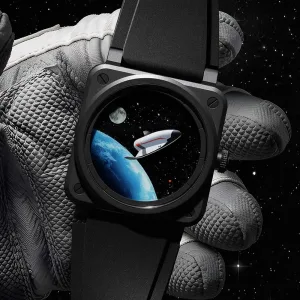
Bell & Ross BR-03 Space Mission: a watch inspired by space exploration
French Air Force watch: history, brands and military-issued models
Certina DS Super PH1000M: an automatic dive watch water-resistant to 1,000 metres
Bell & Ross BR-03 Green Radar Ceramic: time under radar surveillance
Get ready for the next dive! Receive our latest news and inspiration dedicated to military and dive watches.
Subscribe
Editor: Éric Barse
Journalist, entrepreneur, and founder of the websites www.cafe-racer-only.com and www.scooter-3-roues.com, Eric Barse divides his time between his passions: motorcycles, travel, and watches. A graduate of the Saint-Cyr military academy and the 2nd RPIMA (Parachute Regiment) before pursuing a career in communications and digital media, he has a true passion for authentic watches that have accompanied his two-wheeled adventures for many years, from the Indian Ocean to Africa and Latin America!