
Panerai and the combat swimmers
In the history of military dive watches, few brands maintain such a close connection with underwater operations as Panerai. Before becoming a luxury watch manufacturer renowned for its imposing dive watches, the Florentine company was, for several decades, a supplier of equipment to the Italian Navy. Watches, sighting instruments, depth gauges, compasses, and luminous systems were developed with a primarily operational objective: to enable military personnel to carry out their missions in the dark and underwater. From this collaboration emerged some of the most recognizable features of modern watchmaking: the Radiomir, the sandwich dial, the 47mm cushion-shaped case, the Luminor's crown-protecting bridge, and movements offering several days of power reserve.

From florentine origins to supplying military equipment
The story begins in Florence in 1860, when Giovanni Panerai opened a watchmaking shop and workshop on the Ponte alle Grazie. The establishment also served as a watchmaking school, which Panerai presented as the first in the city. The family business then evolved, and the company gradually moved closer to the military world. By the beginning of the 20th century, the Panerai family was already supplying the Italian Navy with precision instruments and sighting systems. This activity is fundamental to understanding the history of Panerai watches: the dive watch was not born as a luxury accessory but as one element of a set of instruments intended for naval operations. Documents preserved by Panerai attest to a collaboration with the Navy dating back to the 1910s. One problem was particularly important at the time: how to read an instrument in the dark?
1916: Radiomir, the innovation that would define Panerai
The answer came in the form of Radiomir. In 1916, Panerai documented the use of this name for a radium-based luminescent material in a patent filed in France. Developed to improve the visibility of instruments and sighting devices used by the Navy, this substance possessed a very high self-luminescence capacity. At a time when neither Super-LumiNova nor miniature electronic lighting was available, this property represented a considerable operational advantage. Radiomir made numbers, markers, and indications visible in the dark. Panerai applied it to various military equipment before this expertise became one of the fundamental characteristics of its watches. We now know that radium presents serious dangers related to its radioactivity. But in the technical context of the early 20th century, its extraordinary luminosity explains its use in numerous instruments.
1935-1936: the birth of the panerai diving watch
A turning point occurred in the mid-1930s. In 1935, the Italian Navy was secretly developing new underwater assault capabilities and training specialized operators. It needed a watch that was robust, waterproof, and legible enough to accompany these men underwater. Navy archives cited by Panerai indicate that Giuseppe Panerai commissioned several prototypes for testing. Among them was the reference 2533, based on a model supplied by Rolex in Geneva and then adapted by Panerai. This collaboration explains an important characteristic of early military Panerai watches: Panerai did not yet manufacture all of its watches in-house. The movements and certain components came from Swiss suppliers, while the Florentine company transformed the whole into a true military instrument. However, the historical reference that truly established the Panerai architecture was the Radiomir 3646.
Panerai Reference 2533

Radiomir 3646: The Iconic Military Panerai
The reference 3646 already possesses almost all the visual elements associated today with a historic Panerai: a massive 47mm steel cushion case, welded wire lugs, a screw-down crown, an extremely minimalist dial, and a long leather strap allowing the watch to be worn over the diver's gear. It houses a Cortebert/Rolex 618 hand-wound mechanical movement, derived from a pocket watch caliber. The 47mm diameter, enormous for its time, is therefore not merely an aesthetic flourish. Underwater, a large display area facilitates immediate time reading. The same principle applies to the famous Panerai sandwich dial. Two plates are superimposed: the upper plate is cut out at the numerals and indices, while the luminescent material is visible through the lower plate. This construction enhances the visibility of the indications in low-light conditions. The layout is deliberately simple: four large Arabic numerals at 12, 3, 6, and 9 o'clock, complemented by wide hour markers. Here, form directly follows function.
Panerai Reference 3646 Type B Radiomir

Italian combat swimmers
These watches are closely associated with the combat swimmers and underwater assault units of the Royal Italian Navy, including the operators of the Decima Flottiglia MAS during World War II. These men notably used piloted underwater assault vehicles, often referred to as human torpedoes. For them, knowing precisely how much time had elapsed was essential operational information. The watch was, in fact, only one part of their equipment. Panerai also developed various navigation and diving instruments: wrist compasses, depth gauges, signaling systems, and lighting equipment. The archives presented today by the brand demonstrate the extent of this military production. However, an important historical distinction must be maintained: not all vintage Panerai watches now classified as "military" can necessarily be individually attributed to a specific unit or mission. Their military development and supply context is established, but the operational provenance of each example must be documented separately.


Panerai and the human torpedoes
Discover the report on the Human Torpedoes produced by the YouTube channel Naval Legends. A leading blog on the history of ships and navies of the first half of the 20th century.
Radiomir models 6152 and 6152/1
After the war, Panerai continued its research for the Italian Navy. References 6152, 6154, and then 6152/1 marked a significant evolution. The case construction became more robust, notably thanks to reinforced lugs integrated from a single block of steel. The 6152/1 is particularly important in Panerai's lineage, as it paved the way for the element that would become the absolute signature of the future Luminor: the crown protection device. Some watches also received the Angelus SF 240 caliber, offering an impressive eight-day power reserve. The military benefit was clear: reducing the frequency of winding limited crown manipulation and therefore potentially reduced wear on the components contributing to water resistance.

Luminor: gradual abandonment of Radiomir
In 1949, Panerai registered the name Luminor for its luminescent materials. The change was significant. The radium used in Radiomir was gradually phased out in favor of a tritium-based compound, which was much less radioactive. From the 1960s onward, the Luminor name also became associated with watches equipped with the famous crown-protecting bridge. This device is remarkably simple: a metal bridge protects the crown while a lever holds it firmly against the case. Panerai obtained an international patent for this system in 1956. It became one of the most instantly recognizable designs in all of watchmaking.
1956: the Egiziano, an extraordinary military watch
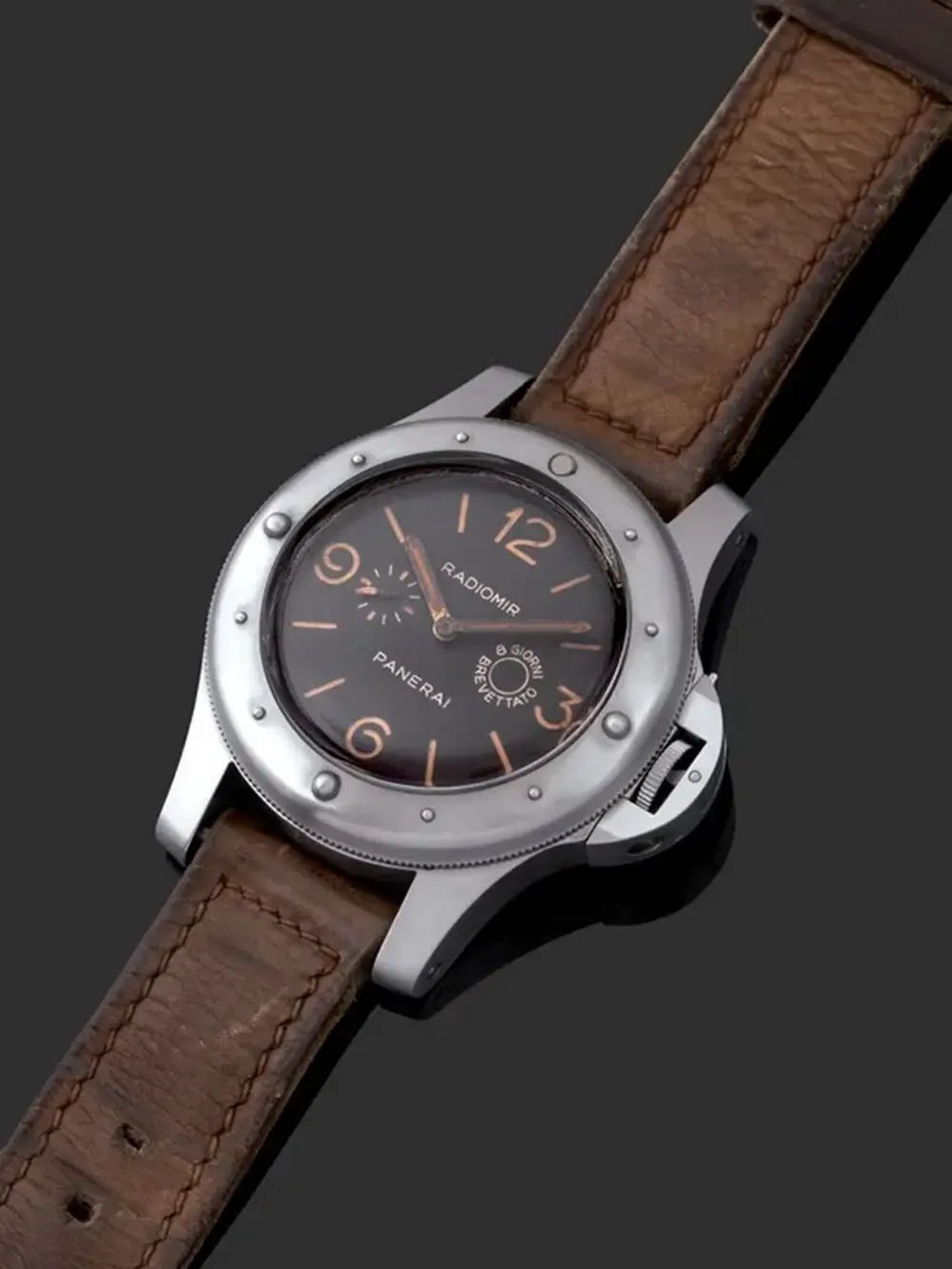
The same year saw the release of another legendary Panerai: the GPF-2/56, later nicknamed Egiziano because it was designed for the Egyptian Navy with the agreement of the Italian Navy. Its dimensions were extraordinary: 60 mm in diameter. But the Egiziano is most interesting for its technical features. It boasts an Angelus movement with an eight-day power reserve, a crown-protecting device, and, most importantly, a graduated rotating bezel for monitoring dive time. It is thus one of the direct ancestors of the philosophy behind today's Panerai Submersible watches.
Panerai Egiziano - 1956 / The model below sold for €121,500 at Arcurial…


Key Panerai military watches to remember
A few models particularly encapsulate this history:
- Radiomir Ref. 2533 — a prototype tested in 1935 to meet the needs of the Italian Navy.
- Radiomir Ref. 3646 — probably the most iconic historical Panerai military watch, with its 47mm cushion-shaped case, exceptionally luminous dial, and wire lugs.
- Ref. 6152 and 6154 — a post-war evolution towards a more robust construction.
- Ref. 6152/1 — a key reference in the transition to the Luminor architecture and the crown-protecting bridge.
- GPF-2/56 Egiziano — a spectacular 60mm watch designed for the Egyptian Navy, equipped with a rotating bezel and an eight-day power reserve movement.
Also worth mentioning is the mysterious Mare Nostrum, a chronograph designed for deck officers. Only a few prototypes were ever made, probably in the 1950s.
Iconic Panerai military watches in detail
Panerai Radiomir Ref. 2533: the prototype that gave birth to the Panerai military watch
The Radiomir Ref. 2533 marks the true starting point of Panerai's military watch history. In 1935, the Royal Italian Navy launched a secret program dedicated to new underwater assault vehicles and their operators. They were looking for instruments capable of functioning in the particularly harsh conditions encountered by these men underwater. Several diving watches were subjected to trials, and according to the Navy's historical archives cited by Panerai, the best result was achieved by the Ref. 2533. The watch was based on a model supplied by Rolex in Geneva, then modified by Panerai to meet Italian military requirements. It particularly benefited from the Florentine watchmaker's expertise in luminescence, thanks to Radiomir, a radium-based material whose name had been documented as early as 1916. The Ref. 2533 should still be considered a prototype rather than a mass-produced watch. But it established the principles that would define future Panerai military watches: large dimensions, excellent legibility, high brightness, and a construction adapted for underwater use. Above all, it paved the way for the famous Ref. 3646.
Panerai Radiomir Ref. 3646: the iconic watch of Italian combat swimmers
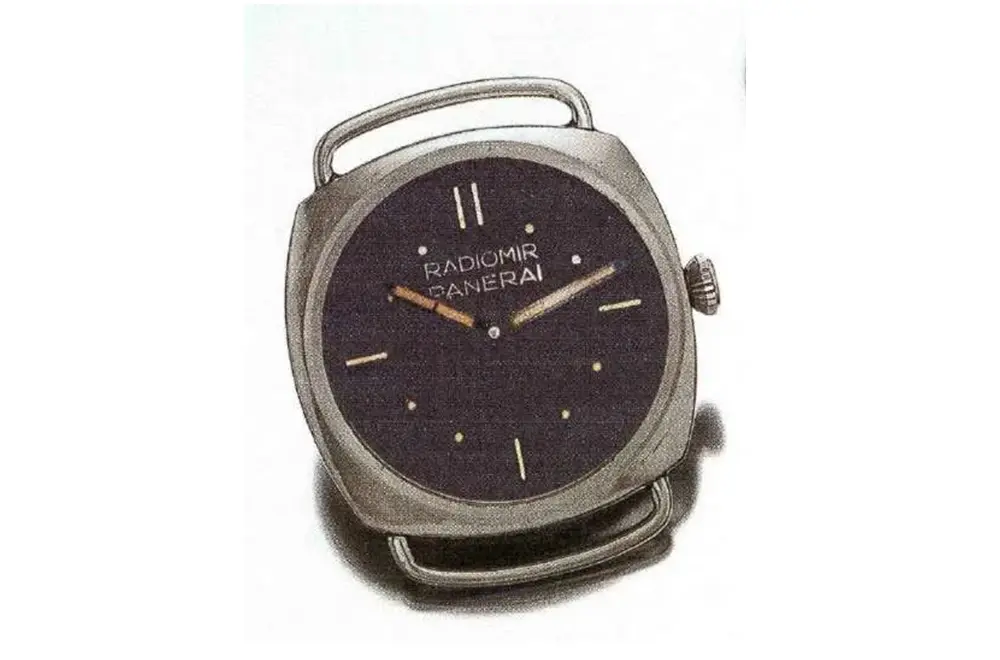
If one watch were to single out and symbolize Panerai's military origins, it would likely be the Radiomir Ref. 3646. Developed following the trials conducted with the 2533, it became a regular issue for the Regia Marina, the Italian Royal Navy. Its design is instantly recognizable: an imposing 47mm cushion-shaped steel case, welded wire lugs, a screw-down crown, and a long leather strap generous enough to be worn over protective clothing. Inside lies a Cortebert/Rolex 618 hand-wound mechanical movement, derived from a pocket watch caliber. But the 3646's greatest strength remains its legibility. Panerai notably perfected its famous sandwich dial, composed of superimposed discs with openworked numerals and indices to reveal the radium-based luminescent material. The objective was by no means aesthetic: the watch had to be easily read in the dark and underwater. The characteristics that make a Radiomir so appealing today are thus directly inherited from the constraints imposed by its military use.
Panerai Ref. 6152: towards a more robust military watch
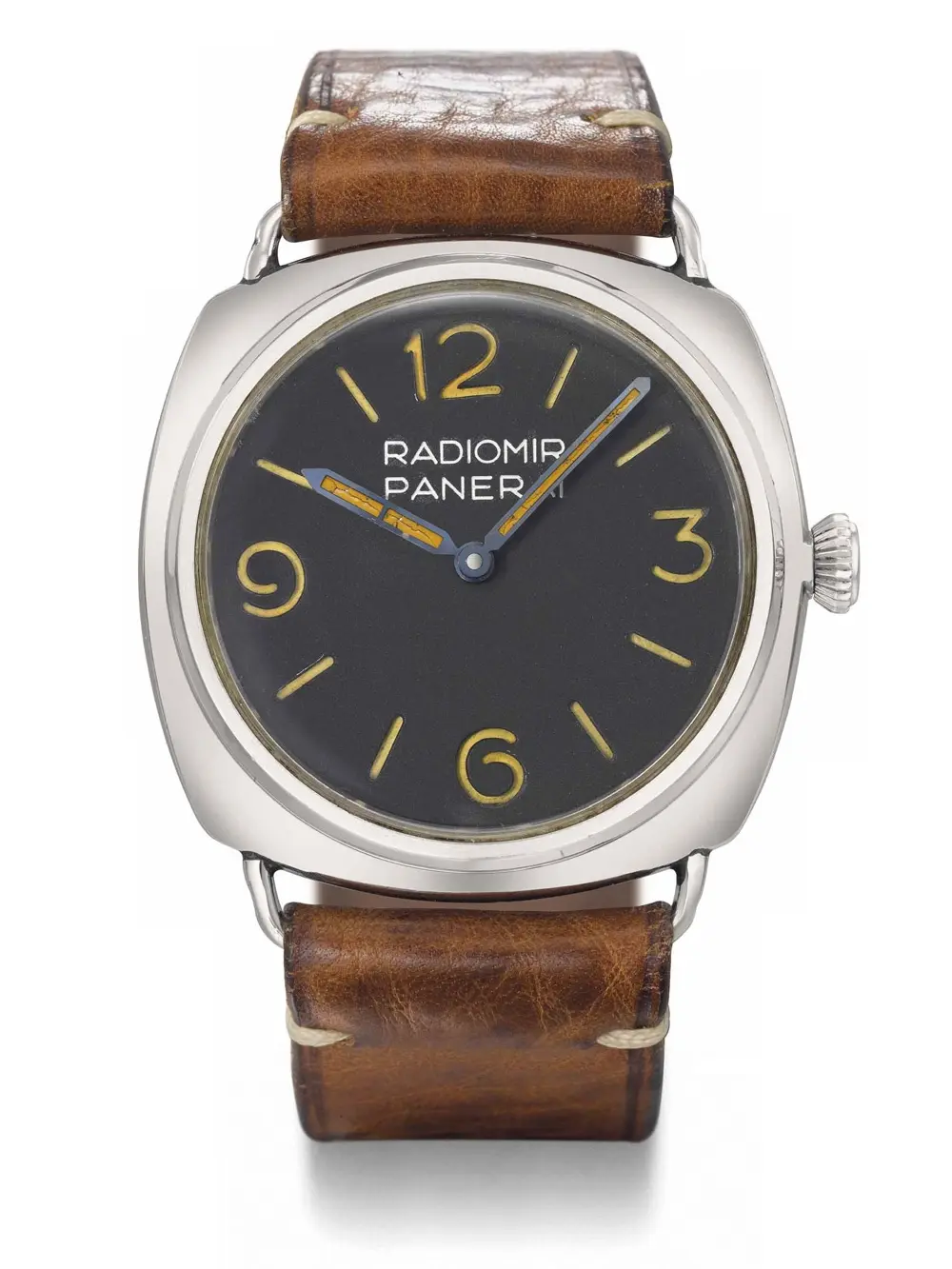
The Panerai Ref. 6152 belongs to a pivotal period in the evolution of the Florentine military watch. The experience gained with the early Radiomir models led Panerai to gradually revise the construction of its diving instruments. The priority remained the same: to offer the Italian Navy an extremely legible, robust watch capable of withstanding the stresses of underwater operations. The historical Radiomir design was retained, with a generous cushion-shaped case and a dial designed for immediate readability. However, Panerai progressively worked on the overall robustness of the case and its lugs. This generation thus represents a particularly interesting intermediate step between the early Radiomir models with wire lugs and the much more distinctive construction that would culminate in the 6152/1. This evolution is crucial in the history of Panerai design: the watch gradually ceased to be simply an adaptation of an existing watchmaking architecture, acquiring increasingly specific technical solutions tailored to the needs of military diving. The 6152 therefore belongs to this pivotal period during which the future identity of the Luminor was gradually taking shape.
Panerai Ref. 6154: a military Radiomir with a clean silhouette
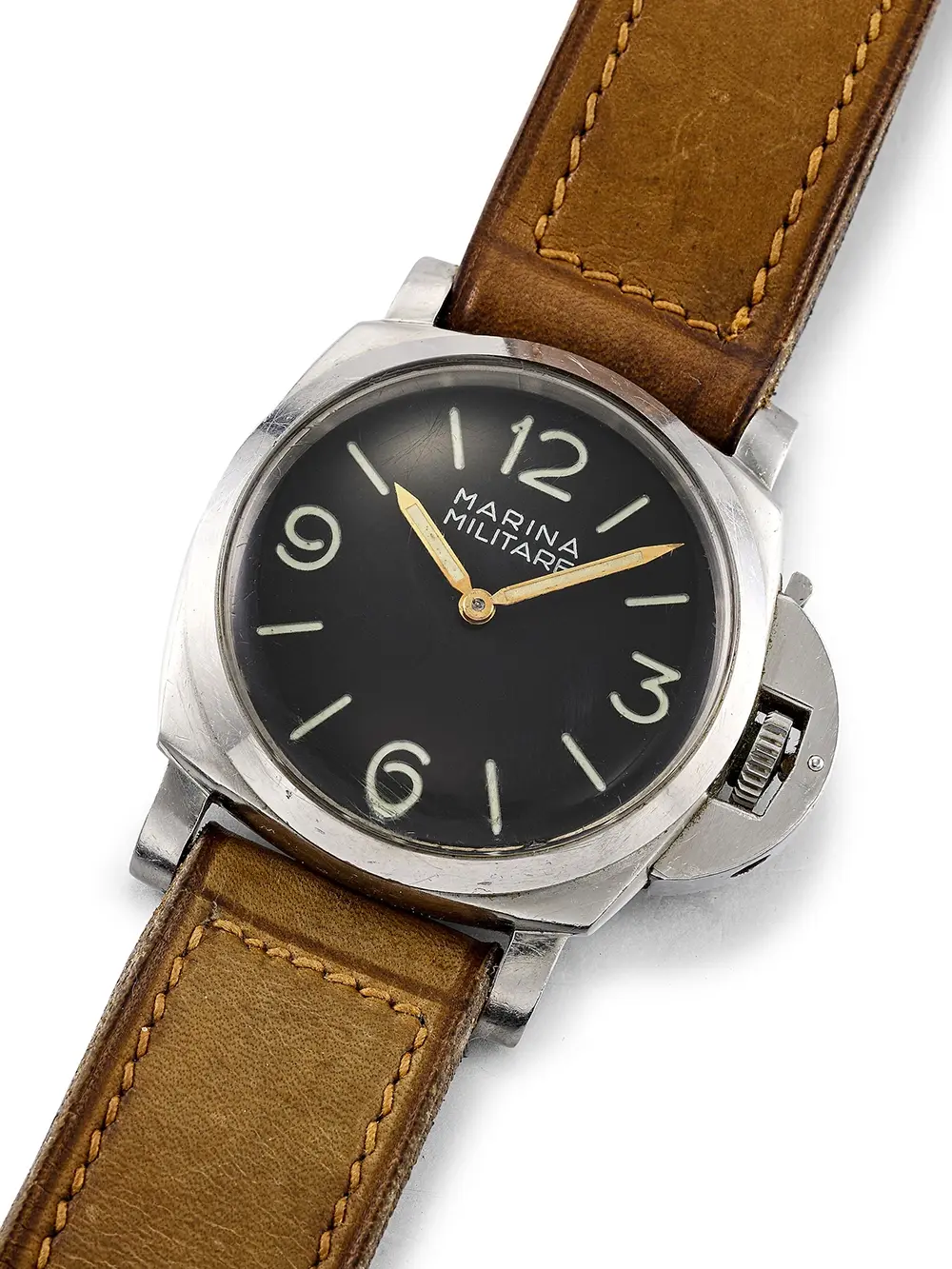
The reference 6154 occupies a special place among historic military Panerai. It belongs to the generation of watches developed after the first Radiomir and retains a particularly pure silhouette, dominated by its large cushion case and its very readable dial. Like other Panerai military watches of this period, its design responds above all to an instrument logic: to limit the information displayed and allow the diver to quickly distinguish the time in difficult conditions. The 6154 also participates in the technical transition which leads Panerai to gradually strengthen the construction of its watches. However, it remains visually closer to the original philosophy of the Radiomir than the models which later adopted the spectacular crown protection bridge. Today, the 6154 is particularly interesting for understanding the evolution of the brand's aesthetic language: imposing case, minimalist dial, large indexes and absolute priority given to readability. Panerai's official historical sources, however, give much less specific detail on the 6154 than on the 3646, 6152/1 or GPF-2/56; it is therefore advisable to avoid assigning it a specific unit or operational configuration without documentation of provenance.
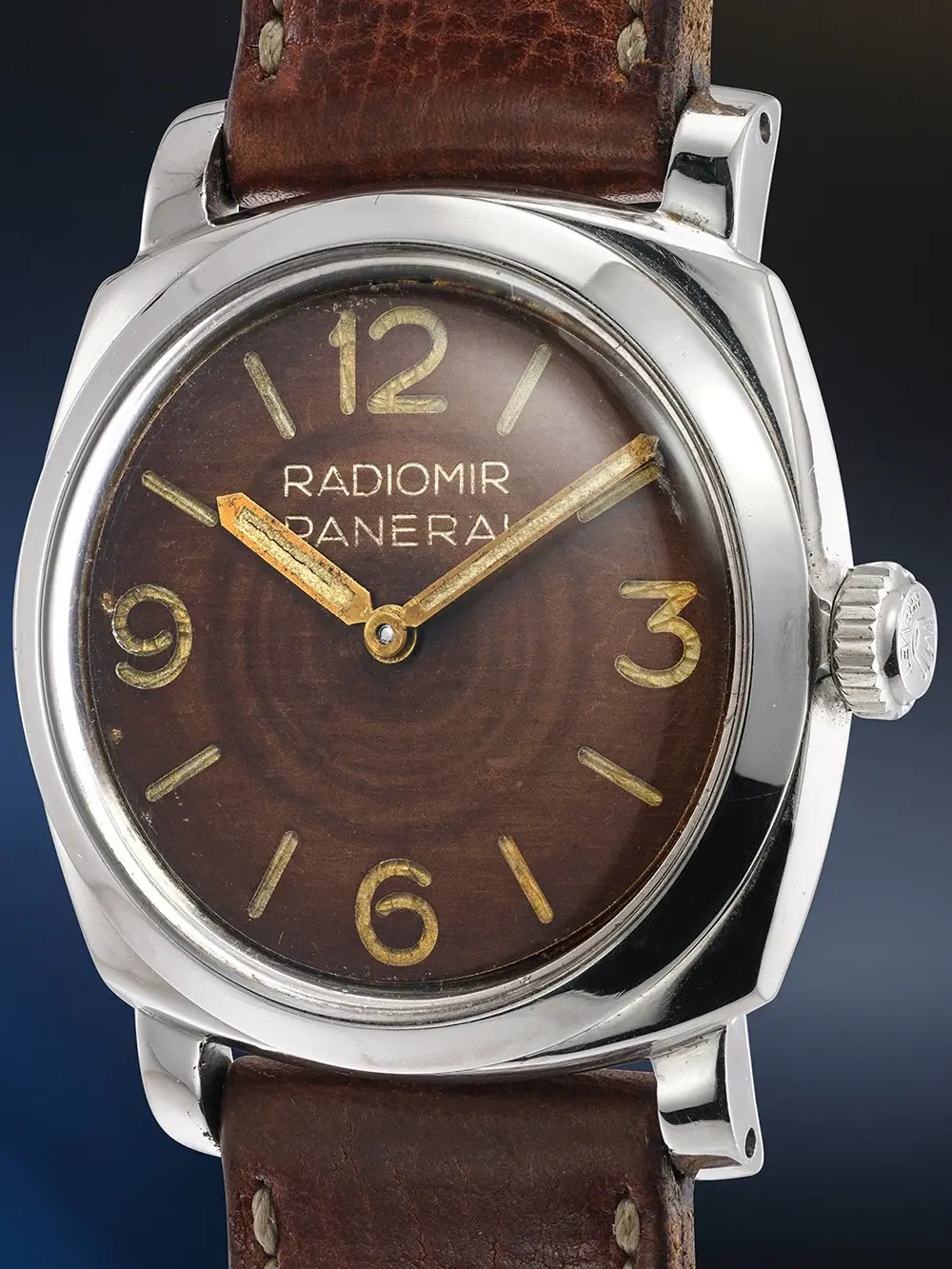
Panerai Ref. 6152/1: the link between Radiomir and Luminor
The Panerai Ref. 6152/1 is one of the most important watches for understanding the emergence of Luminor. Following trials conducted on previous generations, Panerai significantly modified the case construction. The fragile wire lugs of the early Radiomir models gave way to reinforced lugs forged from the same block of steel as the case, considerably improving the overall robustness. But the most dramatic transformation came with the adaptation of the famous crown-protecting bridge to the case of the 6152/1. This device holds the crown firmly against the case while protecting it from shocks. In the 1960s, Panerai also gradually abandoned radium paste in favor of a new tritium-based luminescent compound, named Luminor. Some 6152/1 models also received the Swiss Angelus SF240 caliber, offering a remarkable eight-day power reserve. Panerai indicates that approximately 80 examples were equipped with this movement. With its reinforced case, sandwich dial, crown guard and long-lasting movement, the 6152/1 brings together many of the elements that will form the DNA of the future Luminor family.
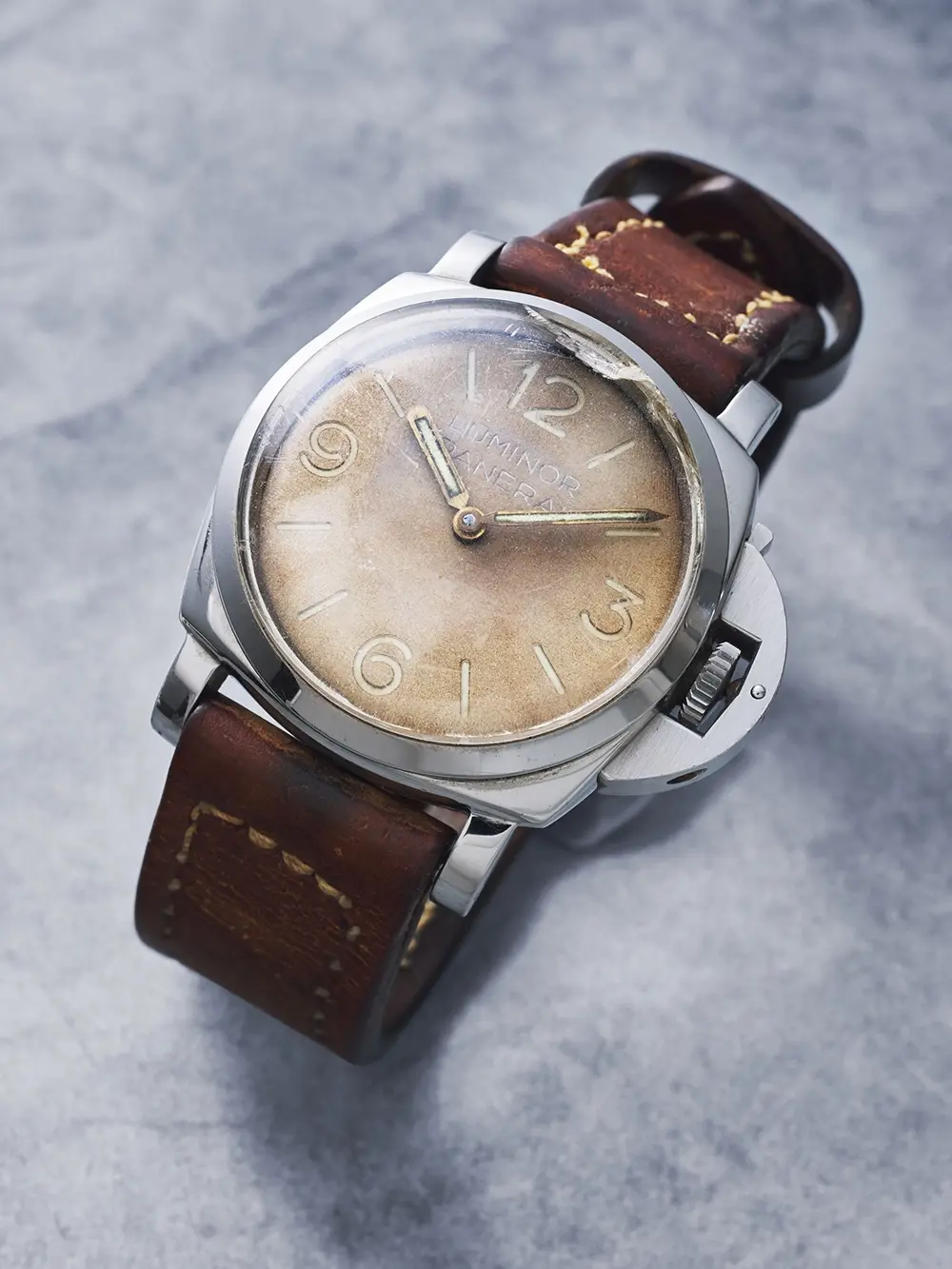
Panerai GPF-2/56 "Egiziano": the 60mm giant designed for the Egyptian Navy
The GPF-2/56, better known as the Egiziano, is probably the most spectacular expression of Panerai's military watch. Developed in 1956, it was intended for the Egyptian Navy, with the agreement of the Italian Navy. Its dimensions immediately convey its character: its case reaches no less than 60 mm in diameter. This exceptional size reflects a quest for robustness and legibility suited to a true underwater instrument. But the Egiziano is not merely gigantic. Panerai equipped it with a graduated rotating bezel for calculating dive time, a function that directly foreshadows the philosophy of the future Submersible models. It also houses a Swiss Angelus movement offering an impressive eight-day power reserve. Another key element: the crown-protecting bridge is structurally integrated into the watch and becomes one of its technical signatures. That same year, Guido Panerai & Figlio obtained an international patent for this device. With its 60mm diameter, functional bezel, power reserve and specifically military design, the Egiziano remains one of the most extraordinary historical Panerai watches ever made.
Panerai Submersible Marina Militare PAM01697: The Next Generation
From its very beginnings, Panerai's history has been closely linked to the military and naval operations. Long before becoming a sought-after collector's item, the Florentine watchmaker designed watches and technical instruments for the Italian Navy. This heritage continues to be honored by Panerai today through some of its collections, as evidenced by the Submersible Marina Militare PAM01697. With its 44mm steel case, gradient green dial, ceramic bezel, and water resistance to 300 meters, this Submersible does not, however, attempt to replicate a historical military watch. It offers a decidedly contemporary interpretation of this heritage, punctuated with references to the Marina Militare and, more specifically, to the world of Italian naval aviation. A modern and robust diver, offered from €12,100 in steel, while its Carbotech version is priced from €19,000.


From military equipment to watchmaking icon
For decades, Panerai remained essentially linked to its military activities, and its watches were not intended for the general public. The turning point came in 1993 when the brand presented its first collections for the civilian market. The Panerai paradox then became clear: what has become an immediately recognizable watchmaking aesthetic was, originally, almost aesthetic in nature. The enormous case had to be legible. The sandwich dial had to glow in the dark. The strap had to fit over a wetsuit. The long power reserve reduced handling. The crown-protecting bridge improved security and water resistance. The bezel of the Egiziano was used to measure dive time. It is precisely this aesthetic, born from military constraints, that still explains Panerai's identity today. Radiomir, Luminor, and Submersible are therefore not simply three families of watches. They represent the different stages of a history that began in Florentine workshops, continued in the Italian Navy's arsenals, and was tested underwater by specialists in submarine operations. More than a century after the Radiomir patent, a Panerai remains instantly recognizable. Few contemporary dive watches so visibly bear the marks of their military origins.
More…
Panerai Submersible Marina Militare PAM01697: a diver's watch that reconnects with the brand's military DNA
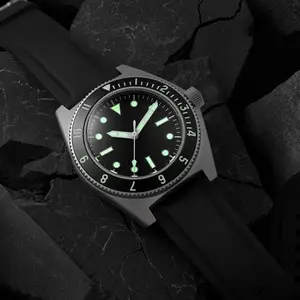
BENRUS Type 1 MIL SPEC: The American military dive watch returns to its roots
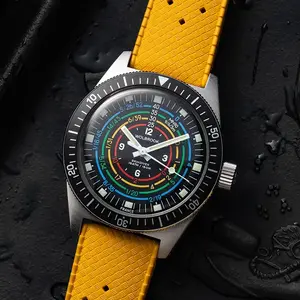
Wolbrook Skindiver Decompression MN90: a dive watch with a design inspired by the French Navy.
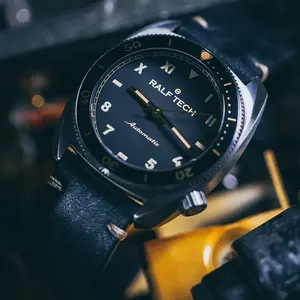
Ralf Tech WRB Automatic California WRB 1007
Get ready for the next dive! Receive our latest news and inspiration dedicated to military and dive watches.
Subscribe
Editor: Éric Barse
Journalist, entrepreneur, and founder of the websites www.cafe-racer-only.com and www.scooter-3-roues.com, Eric Barse divides his time between his passions: motorcycles, travel, and watches. A graduate of the Saint-Cyr military academy and the 2nd RPIMA (Parachute Regiment) before pursuing a career in communications and digital media, he has a true passion for authentic watches that have accompanied his two-wheeled adventures for many years, from the Indian Ocean to Africa and Latin America!