
Christopher Ward C60 Trident Pro 300: the British diver with a Swiss accent
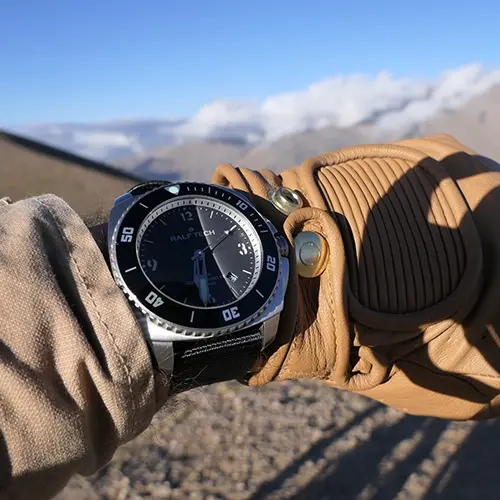
In the highly competitive world of mechanical dive watches, Christopher Ward occupies a rather unique position. Founded in the early 2000s, the British brand has grown by focusing on direct sales and Swiss production, aiming to offer high-performance features without reaching the prices of traditional luxury watchmakers. The C60 Trident Pro 300 perfectly illustrates this strategy. Available in several diameters and colors, this automatic diver combines 300-meter water resistance, a ceramic bezel, a sapphire crystal, and a Swiss Sellita automatic movement. The C60-40ADA31S0KK1-B0 model shown here features a 40mm case, a black dial, and a Bader metal bracelet. While this configuration may seem fairly standard on paper, its appeal lies primarily in how Christopher Ward has managed to combine the characteristics of a true dive watch with dimensions suitable for everyday wear. It is available from €1,050.

Christopher Ward: A Young British Brand Founded in 2004
Unlike manufacturers that emphasize a heritage dating back to the 19th century, Christopher Ward belongs to the new generation of British watchmaking. The company was founded in 2004 by Christopher Ward, Mike France, and Peter Ellis. The idea reportedly took shape during a boat trip on the Thames. The brand's first watch was then launched in 2005. From the outset, Christopher Ward adopted an approach that was far less common than it is today: selling its watches directly online, bypassing the traditional retail network. This direct-to-consumer model quickly became a key component of its identity. The goal was to reduce certain distribution costs in order to focus the final price more on the product itself. The brand remains British in its identity and design, while its watches are made in Switzerland. This dual heritage is symbolized today by the two-flag logo, notably found on the dial of the Trident Pro 300.
From online sales to developing its own movements
Christopher Ward has gradually transcended its initial status as a young brand offering Swiss watches through direct sales. A significant milestone came in 2014 when the company merged with its Swiss production partner, Synergies Horlogères. That same year saw the introduction of the SH21 caliber, a mechanical movement developed under the direction of Johannes Jahnke, notably offering a five-day power reserve. However, not all Christopher Ward watches feature a movement developed by the brand. For the C60 Trident Pro 300, the choice fell on the widely used Sellita SW200-1, a Swiss automatic caliber whose proven architecture is well-suited to the positioning of this diver's watch.
C60 Trident: a collection launched in 2009
The Trident family holds an important place in Christopher Ward's recent history. The first C60 Trident Automatic appeared in 2009. The collection has since evolved several times, notably with the arrival of the Trident Pro 600 and various versions in materials, colors, and movements. To develop the C60 Trident Pro 300, Christopher Ward adopted a rather unusual method: the brand consulted members of its own forum to understand their expectations for a more versatile dive watch. One of the objectives was to offer a watch that was thinner and easier to wear than the C60 Trident Pro 600 while maintaining more than sufficient water resistance for a mechanical dive watch. The result is this Trident Pro 300, available in several diameters ranging from 38 to 44 mm.
A 40 mm case and only 11.3 mm thick
The model we are interested in features the mid-size 40 mm case. This dimension is combined with a lug-to-lug length of 47.45 mm and, most importantly, a slim profile of 11.3 mm. The case alone weighs 68 grams, while the watch reaches approximately 160 grams with its metal bracelet. Christopher Ward uses its signature Light-catcher stainless steel case, which alternates polished and brushed surfaces to visually reduce the watch's mass. Despite this relative slimness, it boasts a water resistance of 300 meters, or 30 ATM. This is an interesting compromise: the Trident Pro 300 maintains specifications consistent with its positioning as a diver's watch while avoiding the thickness often associated with watches offering significant water resistance.
Discover the full specifications of the Christopher Ward C60 Trident Pro 300


Ceramic bezel and Super-LumiNova
The watch naturally features a unidirectional rotating bezel, essential to the identity of a diver's watch. Christopher Ward uses a black zirconia ceramic insert here. The graduations are filled with Super-LumiNova Grade X1 BL C1, as are the hands and dial markers. Nighttime legibility has been given particular attention: the markers have been enlarged compared to some previous generations to increase the amount of luminescent material. The lacquered black dial remains relatively understated. The "twin flags" logo is positioned at 12 o'clock, while the date window is located at 6 o'clock, maintaining a degree of symmetry. The seconds hand also incorporates the famous trident-shaped counterweight, which has become one of the collection's distinctive features. The entire watch is protected by an anti-reflective sapphire crystal.
The Sellita SW200-1 visible through the case back
Inside, the C60 Trident Pro 300 houses an automatic Sellita SW200-1 movement. This 26-jewel Swiss movement operates at a frequency of 28,800 vibrations per hour, or 4 Hz, and offers a claimed 38-hour power reserve. It also features a hacking seconds function for more precise time setting. Christopher Ward states that this configuration has a rate tolerance of -5 to +12 seconds per day. The brand has opted for a transparent case back, allowing a view of the movement and its decorated rotor. This choice is more aesthetic than functional and may divide enthusiasts of traditional dive watches, who sometimes prefer a solid case back. Nevertheless, it serves as a reminder that the C60 remains a Swiss mechanical watch despite its British heritage.
A Bader bracelet designed for everyday wear
This model is offered on the Bader stainless steel bracelet. Christopher Ward equipped it with a quick-change system and a clasp featuring a micro-adjustment mechanism. The links are assembled with screws rather than simple pins. The watch can also be configured with other metal bracelets or various rubber models. This diversity perfectly reflects the philosophy of the Trident Pro 300: to offer a diver's watch sporty enough for use in water, but with a size that remains suitable for everyday wear.
The Christopher Ward C60 Trident Pro 300 Dive Watch: A Diver That Prioritizes Versatility
The Christopher Ward C60 Trident Pro 300 doesn't ultimately seek to revolutionize the concept of the dive watch. Its black dial, steel case, and ceramic bezel employ design codes now well-established in the category. Its appeal lies elsewhere. With a 40 mm diameter, 11.3 mm thickness, 300-meter water resistance, a sapphire crystal, and a Sellita SW200-1 movement, it combines solid features in a relatively compact format. It also reflects the unique journey of Christopher Ward. Starting in 2004 with a model based primarily on direct online sales, the company has gradually become a recognizable player in the Anglo-Swiss watchmaking industry, with its own aesthetic codes and, for certain collections, its own mechanical developments. The C60 Trident Pro 300, however, remains true to a pragmatic approach: using a proven Swiss caliber and focusing its efforts on the case, legibility, finishing, and versatility. This watch therefore doesn't claim to reinvent the mechanical diver's watch, but offers a modern and technically sound interpretation of this horological staple.
More…
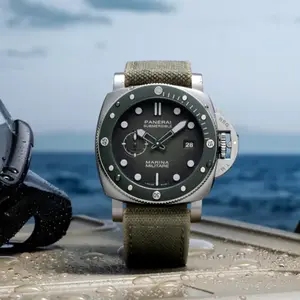
Panerai Submersible Marina Militare PAM01697: a diver's watch that reconnects with the brand's military DNA

Panerai and the combat swimmers
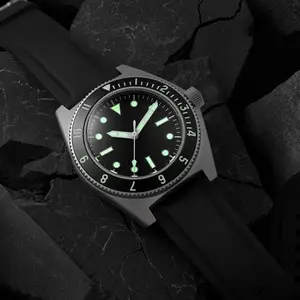
BENRUS Type 1 MIL SPEC: The American military dive watch returns to its roots
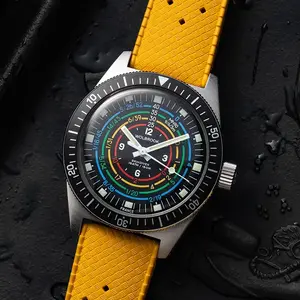
Wolbrook Skindiver Decompression MN90: a dive watch with a design inspired by the French Navy.
Get ready for the next dive! Receive our latest news and inspiration dedicated to military and dive watches.
Subscribe
Editor: Éric Barse
Journalist, entrepreneur, and founder of the websites www.cafe-racer-only.com and www.scooter-3-roues.com, Eric Barse divides his time between his passions: motorcycles, travel, and watches. A graduate of the Saint-Cyr military academy and the 2nd RPIMA (Parachute Regiment) before pursuing a career in communications and digital media, he has a true passion for authentic watches that have accompanied his two-wheeled adventures for many years, from the Indian Ocean to Africa and Latin America!