
Helium valve: the small release mechanism for saturation divers, and the still-disputed question of its origin
It is one of the few features on a dive watch that almost no wearer will ever actually use: the helium escape valve is intended solely for saturation divers—those who spend days living under pressure in a chamber, breathing a helium-rich gas mixture. The problem it addresses does not arise at the bottom of the sea, but during the ascent, when gas that has seeped into the watch case seeks to escape, potentially causing the crystal to pop off. Rolex claims to have invented it, citing a patent filed in 1967; Doxa asserts that it equipped the first commercially available dive watch with such a feature; and some American accounts credit an aquanaut from the U.S. Navy. Three different narratives, a single patent, and a history that is better documented than it is definitively settled.

An issue of ascent, not depth
Contrary to what marketing claims about ultra-water-resistant watches might suggest, the helium escape valve does not provide protection against extreme depths. Instead, it addresses a specific challenge that emerged with saturation diving—a practice involving living for days, or even weeks, in a pressurized, artificial atmosphere. This discipline stems from Project Genesis, launched in 1957 by U.S. Navy physician George F. Bond, who demonstrated that human tissues reach a saturation point beyond which the required decompression time no longer increases. Human trials in 1962 utilized a gas mixture consisting of 21.6% oxygen, 4% nitrogen, and 74.4% helium. A saturation diver does not return to the surface after every shift; they remain under pressure, and their watch stays with them.
Helium penetrates where water cannot
It all comes down to atomic size. A helium atom has a radius of approximately 0.49 angstroms, whereas a water molecule measures nearly 2.75 angstroms. Consequently, a seal that is perfectly watertight may not be gas-tight; helium slowly infiltrates the watch, eventually filling the case after about five days of exposure. As long as the diver remains under pressure, there is no problem. The danger arises during decompression: the ambient pressure drops rapidly, but the trapped gas cannot escape at the same rate. This creates an internal overpressure—a critical issue, given that a watch case is engineered to withstand external pressure, not the reverse. The crystal: the weak link in 1960s dive watches In the 1960s, the crystals of dive watches were typically just press-fitted into the watch case, making them the most fragile part of the entire assembly. When the internal pressure exceeded a certain threshold, the crystal would pop out—sometimes even inside the decompression chamber itself. Before the watchmaking industry addressed the issue, divers devised an improvised solution: unscrewing the crown before decompression to provide an escape route for the gas. Those who forgot would lose their crystal. Even today, many professionals intentionally unscrew the crown during pressurization to equalize the pressure inside the watch case with the atmosphere of their living chamber.
A valve, a spring—and that’s all it takes
The mechanism is remarkably simple: a spring-loaded check valve housed within the watch case. It remains closed as long as the difference between the internal and external pressure does not exceed the force of the spring, but it opens the moment that threshold is crossed. The original Rolex valve consisted of just three parts: a valve stem, a rubber O-ring, and a flat spring. The current version, as described by the brand, is a self-regulating system comprising an airtight cylinder, a piston, a seal, and a spring. Omega, for its part, opted for a patented, conical-shaped valve that can be operated underwater without compromising the watch’s water resistance.


A Swiss patent, an inventor’s name, and a two-and-a-half-year wait
The only document that carries legal weight in this matter is Swiss patent CH492246, titled "Waterproof watch," filed by Montres Rolex SA on November 6, 1967, and granted on June 15, 1970. The named inventor is André Zibach, a watchmaker who worked at Patek Philippe before joining Rolex in the 1960s. The text describes prolonged exposure—lasting hundreds of hours—to pressures equivalent to several dozen atmospheres, which are precisely the conditions encountered during saturation diving. To this day, Rolex maintains that it invented the valve and patented it in 1967; the company also dates the origin of the Oyster Perpetual Sea-Dweller to that same year, noting that its water resistance was 610 meters at launch, later increased to 1,220 meters in 1978. One detail is worth noting: the patent makes no mention of Doxa, nor of anyone associated with the brand.
The Doxa version—and its inconsistent dates
Doxa claims that the SUB 300T Conquistador was the first commercially available dive watch equipped with a helium-release valve. The difficulty stems from the brand itself: its "History" page and product descriptions place the launch in 1968, while its official blog dates the first use of the valve to 1969. Former director Urs Alois Eschle recounted that the device was tested by diver Claude Wesly and that the patent was shared with Rolex in 1968. A Doxa advertisement from the late 1960s touts a "patented helium valve"—with no mention of a patent being "pending"—whereas the early Sea-Dweller models loaned to professionals bore the inscription "Patent Pending" on their case backs. The designs also differ: the Doxa version diverges from the original Sea-Dweller 1665 and is more reminiscent of the second-generation Rolex valve, which appeared in 1978 with the reference 16660.
A third lead: the SEALAB connection
Several American sources attribute the initial concept of the one-way valve to Robert A. Barth, a U.S. Navy diver involved in the Genesis and subsequent SEALAB programs. According to the account, Barth mentioned the phenomenon of watches exploding to T. Walker Lloyd, who allegedly passed the idea on to Rolex before being hired there as an oceanographic consultant. Barth—who considered a rotating bezel unnecessary for a saturation diver, given that six-hour shifts were managed from a control center—knew exactly what he was talking about. SEALAB III, deployed on February 15, 1969, at a depth of 185 meters off the coast of San Clemente Island, was abandoned following the death of aquanaut Berry Cannon. The four aquanauts had entered the habitat wearing Sea-Dweller watches; the three survivors emerged wearing Doxa SUBs. Why the debate remains open The physical evidence points toward the patent, but it does not explain everything: only about 800 Conquistador units were produced—fewer than ten of which have resurfaced—and it remained the only Doxa model with a valve until the arrival of the SUB 1200T in 2010. A parallel, independent development remains the hypothesis most consistent with the available pieces.
Helium escape valve: from specialized component to marketing feature
Comex, founded in Marseille in November 1961 by Henri-Germain Delauze, served as a real-world laboratory for this entire history—from the Hydra I project in 1968 and offshore operations at 534 meters in 1988, to a simulated depth of 701 meters reached by Théo Mavrostomos in 1992. It is often forgotten that Comex worked exclusively with Omega from 1968 to 1971; Omega had taken the opposite approach with the Seamaster 600 "Ploprof," which featured a monobloc case designed to keep helium out rather than allow it to escape. The shift toward Rolex occurred in late 1971, after André Heiniger gifted one hundred co-branded watches to Delauze. Half a century later, the ISO 6425 standard for mixed-gas diving watches requires that timepieces withstand fifteen days at 125% of their rated pressure, followed by decompression in under three minutes—yet it does not mandate an escape valve. Brands like Seiko and Citizen achieve this through specialized gaskets and monocoque cases. Nevertheless, the small valve remains on watch dials, serving more as a badge of belonging than as a functional tool.
More…
MTM Special Ops Cobra 47mm: a titanium chronograph renewed and offered in three finishes
The 5 favourite dive watches of October: five divers’ watches born in contact with their users
Hamilton Khaki Field Mechanical Call of Duty Modern Warfare 4: Captain Price’s watch
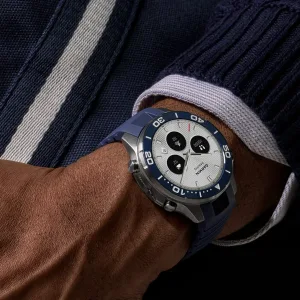
Garmin MARQ Diver (Gen 3): a connected dive watch with no holes in the case
Get ready for the next dive! Receive our latest news and inspiration dedicated to military and dive watches.
Subscribe
Editor: Éric Barse
Journalist, entrepreneur, and founder of the websites www.cafe-racer-only.com and www.scooter-3-roues.com, Eric Barse divides his time between his passions: motorcycles, travel, and watches. A graduate of the Saint-Cyr military academy and the 2nd RPIMA (Parachute Regiment) before pursuing a career in communications and digital media, he has a true passion for authentic watches that have accompanied his two-wheeled adventures for many years, from the Indian Ocean to Africa and Latin America!