
The watch from the world record scuba diving: -332.35 meters!
Descending to depths of over 300 meters with self-contained underwater breathing apparatus (SCUBA) is a far cry from recreational diving. At these depths, the pressure, the management of breathing gases, and especially decompression require considerable preparation and logistical planning. Yet, on September 18, 2014, Egyptian Ahmed Gabr descended to 332.35 meters in the Red Sea, off the coast of Dahab, Egypt. This feat remains recognized by Guinness World Records as the deepest scuba dive in seawater. A spectacular achievement, but the raw figure only tells part of the story. While Gabr needed only about fifteen minutes to reach his maximum depth, his return to the surface took nearly fourteen hours. Behind the record lie several years of preparation, dozens of tanks, various breathing gas mixtures, and an entire team dedicated to ensuring the safety of the operation.

Ahmed Gabr, from the military to technical diving
Ahmed Gabr didn't arrive in Dahab as an amateur diver simply looking to push his limits. An officer in the Egyptian Army's special forces, he already possessed significant diving experience and had notably completed the US Army Combat Diver Course. Guinness World Records indicated at the time of the record attempt that he had 17 years of experience as an instructor and had dedicated the previous four years to preparing for his dive. This preparation wasn't limited to technical aspects. Gabr explains that he worked on his cardiovascular fitness, but also on his mental preparation through meditation, breathing exercises, and visualization. The project initially aimed for an even greater depth: 350 meters.
September 18, 2014: Heading for the depths of the Red Sea
The attempt was ultimately organized south of Dahab, in the Sinai Peninsula, in the Red Sea. The geographical conditions of the site allowed for rapid access to very great depths, an essential element for an operation of this nature. The principle is relatively simple on the surface: a descent line marks the path to the target depth. But the technical reality is obviously much more complex. Gabr descends rapidly. According to various sources, it takes him approximately 12 to 15 minutes to reach the record zone. Guinness officially recognizes a depth of 332.35 meters, or 1,090 feet and 4.5 inches. At this depth, the absolute pressure is approximately 34 bars. In other words, each stage of the dive must have been planned, taking into account physiological constraints that are far removed from those of a recreational dive.


The real challenge: returning to the surface
Reaching 332.35 meters is the spectacular image of the record. Yet, the longest part begins precisely when Gabr decides to ascend. The deeper a diver descends, the more critical managing the dissolved gases in their body becomes. A direct ascent to the surface is impossible. Gabr must therefore perform a series of decompression stops. His own account states a total dive time of 13 hours and 50 minutes, including a 14-minute descent and a 13-hour and 36-minute ascent. The last 27 meters alone would have required approximately seven hours. Guinness World Records, on the other hand, mentions a return to the surface that took nearly 15 hours. These differences stem from the accounting methods used by the various sources, but all illustrate the disproportion between the descent and the ascent. The depth record is therefore as much a feat of decompression as it is a feat of descent.
The CX Swiss Military 20,000 FEET, a record-breaking watch to accompany Ahmed Gabr
The choice of watch worn by Ahmed Gabr during his world record dive was far from insignificant. On September 18, 2014, when he descended to 332.35 meters off the coast of Dahab, the Egyptian diver was accompanied by a CX Swiss Military Watch 20,000 FEET, a timepiece developed by the Swiss watchmaker Montres Charmex SA. A watch industry source published a few days after the achievement confirmed the presence of this 20,000 FEET during the record-breaking dive. The connection between the diver and the brand appears particularly fitting: a few years earlier, the watch itself had been designed to push the limits of pressure resistance.
A watch capable of reaching a depth of 6,000 meters
In January 2009, the CX Swiss Military 20,000 FEET was certified to operate at a depth equivalent to 6,000 meters, a performance then recorded as a record for a mechanical dive watch. To achieve such a level of resistance, the watch features an exceptional construction, with an imposing 46 mm titanium case, approximately 28.5 mm thick, and, most notably, a domed sapphire crystal reaching 10 mm in thickness. It also has a unidirectional rotating bezel, a screw-down crown and pushers, and a helium escape valve. Inside is an ETA Valjoux 7750, a COSC-certified automatic chronograph movement operating at 28,800 vibrations per hour. The presence of this watch on Gabr's wrist creates a rather rare association between two extreme performances: that of a diver who has surpassed 330 meters in scuba gear and that of a mechanical watch designed to withstand significantly higher pressures. At 332.35 meters, the CX Swiss Military was indeed well beyond its theoretical limit. More than just product placement, this association allowed the brand to juxtapose its image as an extreme diver with a genuine technical diving expedition, while giving Ahmed Gabr's record a particularly interesting horological dimension. The CX Swiss Military 20,000 Feet is still available for purchase at around €3,990.


Dozens of bottles and several gas mixtures
A dive to 332 meters obviously cannot be achieved with a simple compressed air tank. The partial pressure of the different gases becomes a determining parameter as the depth increases. Planning therefore relies on the use of different breathing mixtures and gas changes made during the ascent. Available sources give slightly different figures on total logistics. Egypt Today reports the use of approximately 90 cylinders of different gas mixtures and a team of 14 support divers. The XDEEP project also describes several dozen tanks and explains that support divers accompanied Gabr from depths exceeding 150 meters. The equipment evolved even during the dive. For the deep end, Gabr used a dorsal configuration combined with additional bottles. During the long decompression phase, a switch to a sidemount configuration was planned in order to reduce the physical load and allow him to adopt a more comfortable position.
A record that surpasses that of Nuno Gomes
Before Ahmed Gabr, the record was held by South African diver Nuno Gomes. In 2005, it reached 318.25 meters, also in the Dahab region. Gabr therefore improves the mark by more than 14 meters. The performance is officially controlled by Guinness World Records. Several independent witnesses participate in the verification process, while the depth is notably materialized by a line specially prepared for the occasion. The initial objective of 350 meters was not achieved, but the 332.35 meters were more than enough to set the new record.
A record contested then re-examined by Guinness
However, the story takes a twist several years after the dive. In 2020, Guinness World Records received anonymous allegations questioning certain aspects of the attempt: differences between the dive plan and its progress, observations concerning gas mixtures, data provided by certain instruments, calculation of the angle of the line or even manipulation of depth markers. Rather than dismissing the accusations, Guinness is opening a review of the case between September 2020 and January 2021. The organization is seeking the opinion of the British Sub-Aqua Club in particular and re-examining three independent witnesses as well as the Guinness arbiter present during the attempt. Its conclusion is unambiguous: the investigations provide no conclusive evidence to establish fraud. Guinness therefore officially maintains Ahmed Gabr's record at 332.35 meters.
World Record for Scuba Diving: A Figure Not to Be Confused with Recreational Diving
The spectacular nature of this record should not lead one to believe that such a depth is an achievable goal for a traditional diver. Recreational diving takes place at infinitely shallower depths. Gabr's performance belongs to the realm of extreme open-circuit technical diving, with organization and risks far exceeding those of a typical dive. This is precisely what makes the record so unique. At 332.35 meters, the descent is ultimately only the shortest part of an operation whose main objective is to return to the surface. Behind the few minutes required to reach the deepest point lie four years of preparation, a large team, and nearly fourteen hours dedicated to the ascent and decompression. More than ten years after that day in September 2014, Guinness World Records continues to recognize Ahmed Gabr as the record holder.
More…

Christopher Ward C60 Trident Pro 300: the British diver with a Swiss accent

Panerai and the combat swimmers
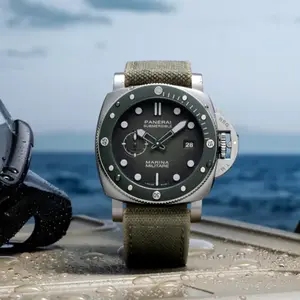
Panerai Submersible Marina Militare PAM01697: a diver's watch that reconnects with the brand's military DNA
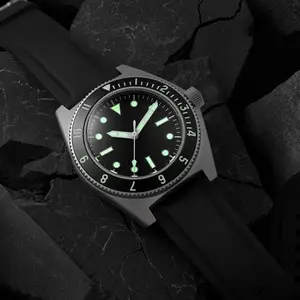
BENRUS Type 1 MIL SPEC: The American military dive watch returns to its roots
Get ready for the next dive! Receive our latest news and inspiration dedicated to military and dive watches.
Subscribe
Editor: Éric Barse
Journalist, entrepreneur, and founder of the websites www.cafe-racer-only.com and www.scooter-3-roues.com, Eric Barse divides his time between his passions: motorcycles, travel, and watches. A graduate of the Saint-Cyr military academy and the 2nd RPIMA (Parachute Regiment) before pursuing a career in communications and digital media, he has a true passion for authentic watches that have accompanied his two-wheeled adventures for many years, from the Indian Ocean to Africa and Latin America!